
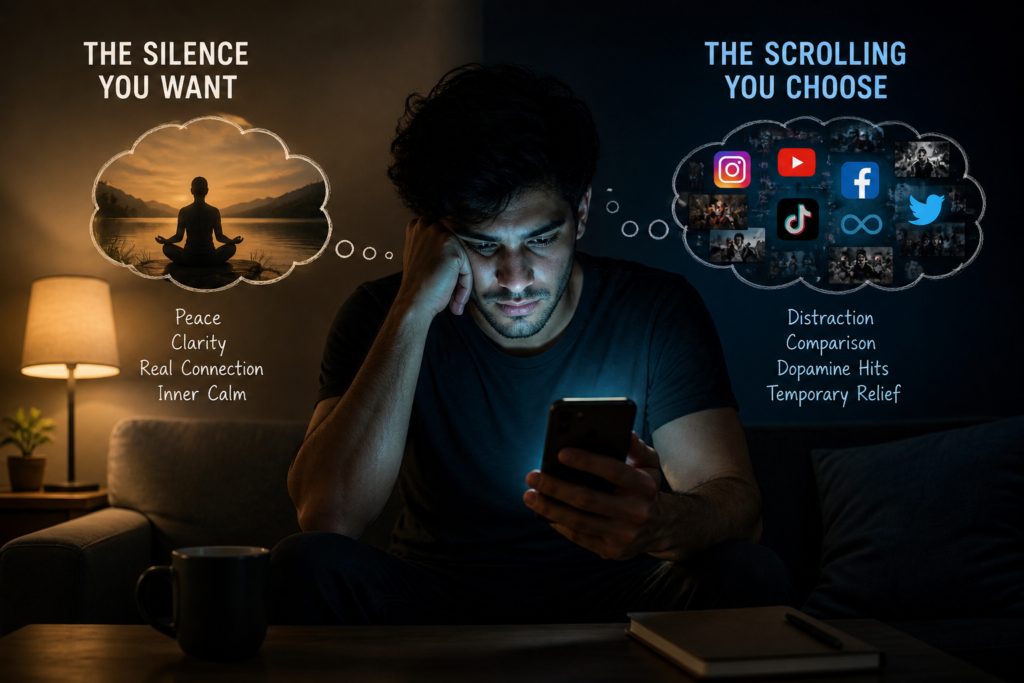
You say you want peace, but the moment things get quiet, you reach for your phone. Not because you’re busy, and not even because you’re bored, but because silence feels heavier than stimulation.
This contrast defines a major pattern in modern behavior. People struggle to sit in silence for even a few minutes, yet can scroll endlessly for hours without resistance. This is not a coincidence. It reveals something fundamental about how the mind works.
At first glance, it may seem like a problem of habit or discipline. But if you look deeper, it becomes clear that the issue is psychological. The mind is conditioned to avoid stillness and seek stimulation. This tendency explains why meditation feels difficult for most people, especially in the beginning, but also why hidden desires quietly take over attention when left unchecked.
Understanding this pattern is the first step toward changing it. This deeper resistance of the mind often goes unnoticed but plays a crucial role in shaping behavior.

Why Silence Feels So Uncomfortable
Silence is often associated with peace, but for most people, it feels anything but peaceful. When external noise disappears, internal noise becomes more noticeable. Thoughts that were previously in the background begin to surface more clearly. Worries, memories, unfinished conversations, and random impulses start appearing all at once. This sudden exposure creates discomfort.
The mind is not used to observing itself without distraction. It is used to react, engage, and move from one stimulus to another. When that flow stops, it does not immediately relax. Instead, it becomes restless. This is why sitting quietly can feel more difficult than staying mentally engaged. Silence removes the buffer that usually protects you from your own thoughts.
This inner conflict is also explored in our article “Why Saints Like Ramakrishna Warn Against Sexual Desires on the Path to Nirvana,” where we examine how spiritual seekers struggle with rising worldly thoughts during meditation.
Why Scrolling Feels Effortless and Addictive
Scrolling provides the exact opposite experience. It offers continuous stimulation without requiring effort. Every swipe brings something new, something different, something that captures attention for a brief moment. This constant novelty keeps the mind engaged without demanding focus or depth.
From a psychological standpoint, this creates a reward loop, as seen in research on attention and digital behavior. The brain responds to novelty and anticipation, making scrolling feel satisfying even when the content itself is not meaningful. The act of scrolling becomes the reward. It fills the space that silence would otherwise occupy and replaces awareness with distraction.
This is also where hidden desires come into play. When the mind seeks stimulation, it is naturally drawn to content that triggers curiosity, attraction, or emotional response. These desires may not always be conscious, but they influence behavior in subtle ways. The result is prolonged engagement without intentional choice.
What many people call entertainment is often a subtle form of psychological escapism used to avoid silence, emotional discomfort, and deeper self-awareness.
The Hidden Role of Desire in This Pattern
Desire plays a central role in why people choose stimulation over stillness. It does not need to be intense to be effective. Even mild curiosity or attraction can keep the mind engaged for long periods. Desire gives the mind something to pursue, something to focus on, something to feel.
When silence begins to feel uncomfortable, the mind looks for the easiest escape. Desire provides that escape. It offers immediate engagement without effort. This is why people often find themselves consuming content they did not plan to engage with. It is not always a conscious decision. It is a response to discomfort.
Over time, this pattern becomes reinforced. The mind starts associating silence with discomfort and stimulation with relief. As a result, the ability to sit quietly weakens. What once felt neutral begins to feel difficult, and what once felt optional becomes habitual.
Why You Avoid Being Alone with Your Thoughts
Being alone is not the same as being in silence. You can be physically alone and still mentally occupied. Silence, however, removes that occupation. It brings attention inward.
When you are left without distraction, you begin to notice recurring patterns in your thinking. Thoughts that were ignored start demanding attention. Emotional undercurrents become more visible. This can feel unfamiliar and unsettling.
The mind prefers familiarity. This is part of a larger pattern where the mind resists growth and avoids change. It gravitates toward patterns it already knows, even if they are not beneficial. Silence introduces uncertainty. It disrupts the usual flow of distraction and forces observation. This is why many people avoid it without realizing it. It is not that they dislike peace. It is that they are not comfortable with what silence reveals.
The Psychological Loop of Discomfort and Escape
t the core of this behavior is a repeating loop, often explained through habit loop and behavior patterns. Discomfort arises in moments of stillness. The mind seeks escape through stimulation. Temporary relief is experienced. Then the discomfort returns. This cycle continues throughout the day, often without conscious awareness.
The more this loop repeats, the stronger it becomes. It turns into an automatic response. You do not consciously decide to avoid silence. You simply feel the urge to engage with something. The action feels natural, even though it is driven by avoidance.
Breaking this loop requires awareness. Not force, not suppression, but recognition. Once you begin to see the pattern, you create a small gap between impulse and action.
Why Meditation Feels Hard in a Stimulated Mind
Meditation challenges this entire pattern. Instead of seeking stimulation, it invites stillness. Instead of escaping thoughts, it encourages observation. This shift can feel uncomfortable for a mind that is used to constant engagement.
Many people assume meditation is not working because they experience restlessness. In reality, they are encountering the same mental activity that has always been present. The difference is that there is no distraction to hide it.
Meditation does not create discomfort—it reveals it, as shown in studies on mindfulness and awareness. And that is why it feels difficult in the beginning. The mind resists because it is being asked to do something unfamiliar.
The Cost of Constant Stimulation
While stimulation may feel harmless, its effects accumulate over time. Attention becomes fragmented. Focus weakens. The ability to stay with one thought or one activity decreases. Patience reduces.
This does not only affect meditation. It impacts daily life. Tasks that require concentration feel harder. Moments of stillness feel longer. Even relaxation becomes dependent on external input.
The mind, conditioned to constant stimulation, loses its ability to rest naturally. It becomes dependent on engagement to feel normal.
What Changes When You Sit in Silence
The shift begins slowly. At first, you notice the discomfort. Then you start recognizing patterns in your thoughts. Over time, the intensity of those thoughts reduces.
You do not stop thinking. You stop reacting to every thought. This creates space. In that space, clarity begins to emerge.
Silence becomes less threatening. It becomes neutral. And eventually, it can even feel grounding. This change does not happen through force. It happens through familiarity.
Reclaiming Attention in a Distracted World
The goal is not to eliminate stimulation completely. It is to reduce unconscious dependence on it. Start by noticing your impulses. When you reach for your phone, pause for a moment. Ask yourself whether it is out of necessity or discomfort.
Create small moments of silence in your day. Even a few minutes without distraction can begin to shift your relationship with stillness. There is no need to force anything. Just allow the moment to exist.
Over time, the mind adapts. What once felt uncomfortable becomes manageable. The need for constant stimulation decreases.

Final Thought
You do not struggle with silence because you lack discipline. You struggle because your mind has been trained to avoid it. You do not scroll endlessly because you lack control. You scroll because stimulation feels easier than awareness.
Once you begin to see this clearly, something changes. You may still feel the urge to escape. You may still choose distraction at times. But you also begin to notice the alternative.
And in that awareness lies the possibility of a different way of being.
#Mindfulness, #Psychology, #SelfAwareness, #DigitalDetox, #MentalHealth, #Meditation, #Focus, #HumanBehavior, #Overthinking, #AttentionSpan, #InnerPeace, #Distraction, #PersonalGrowth, #Awareness, #Dopamine



Pingback: Why Meditation Fails for Most People: The Hidden Struggle No One Talks About - Eastside Writers
Pingback: The Hidden Resistance to Meditation: What Your Mind Doesn’t Want You to Know - Eastside Writers
Pingback: Why Your Mind Resists Growth: From Meditation to Desire, the Hidden Pattern Controlling Your Life - Eastside Writers
Pingback: God Hidden in Man: The Forgotten Science of Consciousness in an Overstimulated Civilization - Eastside Writers
Pingback: Nobody Listens Anymore — And That Is Why There Is No Peace Left In Our Homes - Eastside Writers
Pingback: Why Understanding Yourself Is the Hardest Journey in Life - Eastside Writers