
There comes a strange phase in life that very few people openly speak about. You begin meditating, protecting your peace, and slowly distancing yourself from unnecessary chaos. The mind becomes quieter, but strangely, the world around you starts feeling louder than ever before.
Conversations begin sounding repetitive. Crowded places start exhausting you emotionally. You reply less, observe more, and somewhere in that silence, an uncomfortable feeling quietly begins to emerge — a feeling that sits somewhere between solitude and loneliness.
And then the real question arises:
If meditation creates peace, and peace creates solitude, then why does that solitude sometimes feel painfully isolating in a world addicted to stimulation?
This is the paradox modern spirituality rarely discusses honestly. The world glorifies mindfulness, inner peace, emotional healing, and discipline, but almost nobody talks about the emotional isolation that often accompanies genuine transformation.
Everyone desires the final version of growth. Very few are prepared for the silent psychological distance that the process itself creates.
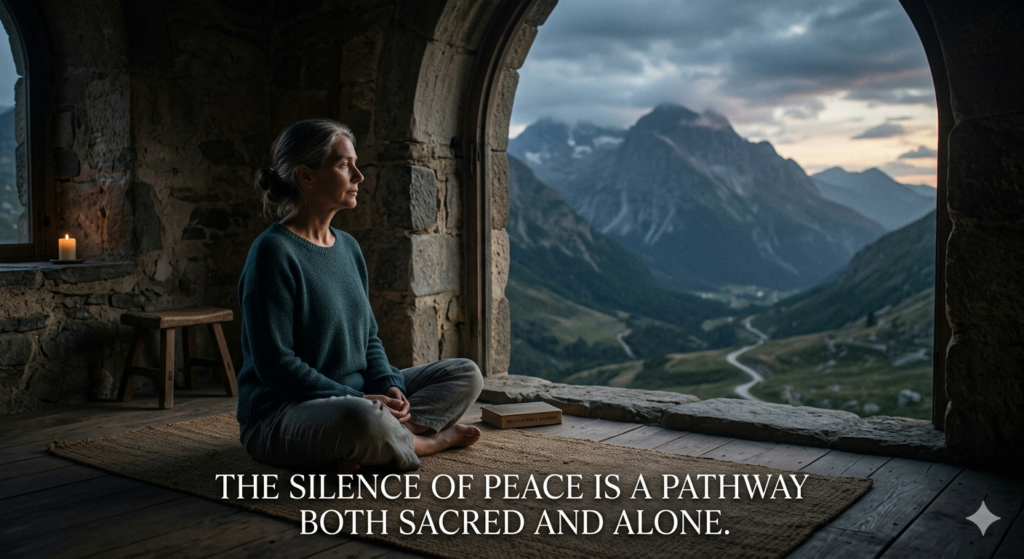
The World Celebrates Results but Ignores Transformation
Modern society celebrates visible outcomes. Confidence, success, wisdom, emotional stability, discipline, and self-control are admired only after they become externally visible. What people rarely acknowledge is the invisible emotional labor required to build those qualities.
Nobody applauds the repetitive mornings, the self-correction, the restraint, the emotional exhaustion, or the loneliness of rebuilding oneself internally. The process itself is rarely glamorous because true growth often happens in silence, far away from applause and validation.
Real transformation usually occurs in places nobody notices — inside thoughts, habits, emotional conflicts, and long periods of internal struggle. Perhaps this is why so many people mistake solitude for loneliness, because externally, both appear almost identical.
But internally, they are profoundly different experiences.
Solitude and Loneliness Are Not the Same Reality
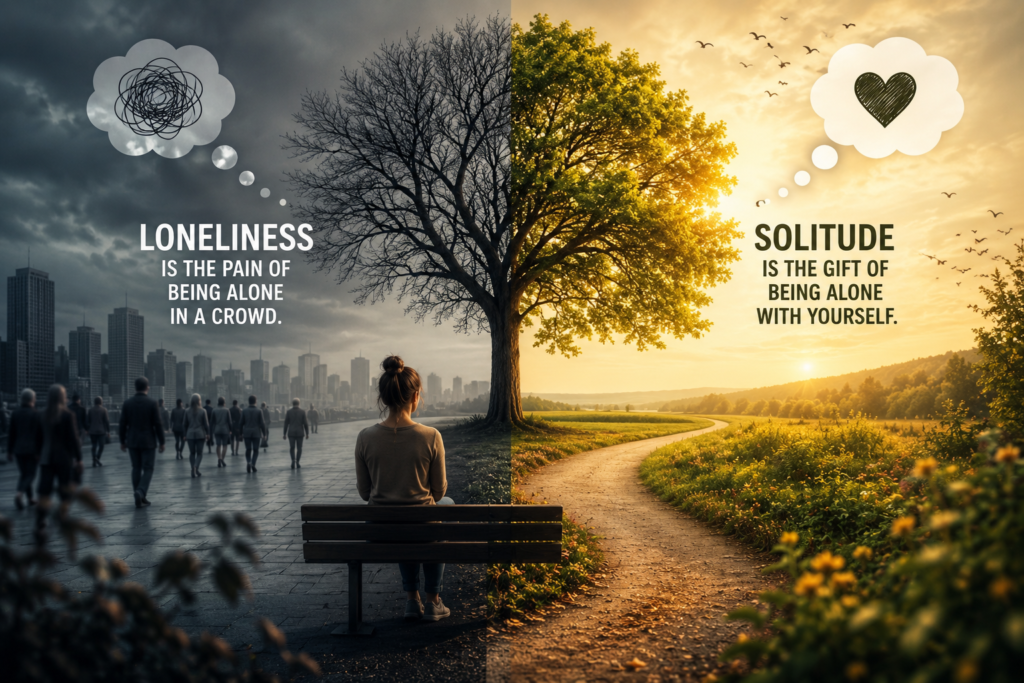
Psychology itself clearly differentiates solitude from loneliness. Loneliness is often defined as the painful perception of emotional disconnection, whereas solitude can become a restorative and psychologically healthy state when experienced consciously. Research on Solitude vs Loneliness
Yet the reality is far more nuanced than most motivational content suggests. Solitude is not always peaceful, and loneliness is not always social. A person can sit among hundreds of people and still feel emotionally abandoned, while another may spend hours alone and feel deeply connected to existence itself.
The real difference lies in one’s inner relationship with silence.
Loneliness whispers:
“Nobody understands me.”
Solitude whispers:
“For the first time, I am beginning to understand myself.”
But during deep transformation, these two states often overlap. That overlap becomes psychologically painful because growth itself creates a temporary identity vacuum. You are no longer who you once were, but you are also not yet the person you are becoming.
And within that fragile space, even meaningful solitude can temporarily feel like emotional exile.
Many ascetic traditions believed solitude becomes even more powerful when combined with detachment from external identity. This principle is explored in “Why Some Spiritual Traditions Reject Clothing: The Hidden Psychology of Ego and Enlightenment“.
Meditation Changes Your Relationship With Stimulation
Most people approach meditation believing it will simply calm the mind. But genuine meditation does something much deeper — it changes your relationship with stimulation itself. It slowly alters what excites you, what drains you, what feels meaningful, and what no longer deserves your emotional energy.
As inner silence deepens, external noise becomes increasingly noticeable. You begin detecting superficiality faster, emotional manipulation more clearly, and the exhausting nature of constant stimulation more intensely.
The things that once entertained you begin feeling emotionally empty. As explored in Where Has Peace Gone?, modern life has normalized mental overstimulation to such an extent that many people now fear silence more than chaos itself.
This creates a strange social paradox. The more peaceful you become internally, the more disconnected you may appear externally. People may assume you have become distant, arrogant, detached, or emotionally unavailable, when in reality, you are simply no longer emotionally dependent on noise.
And in a civilization built upon endless stimulation, silence itself begins to look abnormal.
The Modern World Is Terrified of Silence
We live in an age where distraction has become a lifestyle. Silence is instantly filled with scrolling, notifications, entertainment, gossip, and endless consumption. The modern mind is rarely allowed to sit quietly with itself long enough to understand what it genuinely feels.
Perhaps this is why genuine inner reflection has become so rare today. In God Hidden In Man, we explored how human beings continuously search outside for answers that often lie buried within their own consciousness.
Meditation intensifies this encounter with the self. At first, many people expect peace to feel comforting, but peace often exposes hidden chaos before it creates stability. It reveals unresolved pain, emotional dependency, suppressed fears, identity confusion, and the terrifying realization of how noisy the human mind actually is.
That phase can feel deeply isolating. Not because meditation is harmful, but because awareness dismantles illusions that previously kept the mind distracted.
Silence becomes frightening because it forces human beings to finally meet themselves without distraction.
The Cyclic Nature of Inner Growth
Personal evolution is not linear. It moves in cycles — growth followed by confusion, clarity followed by emptiness, discipline followed by emotional exhaustion. This fragmented rhythm is one of the most misunderstood aspects of self-transformation.
You meditate for months, and suddenly, confusion returns. You work on yourself deeply, yet loneliness resurfaces again. You begin seeking peace, yet somehow feel increasingly separated from society.
Most people interpret these phases as failure. In reality, they are often periods of psychological integration where the mind is restructuring itself internally.
This is why growth can feel fragmented rather than progressive. The mind frequently breaks old emotional patterns before new stability fully forms.
Studies around mindfulness practices have also suggested that meditation may reduce emotional distress and feelings of loneliness by fundamentally changing one’s relationship with thoughts, emotions, and inner awareness. Mindfulness and Loneliness Study
Why Deep Growth Quietly Changes Relationships
Every major inner transformation eventually affects outer relationships. Growth changes perception, perception changes emotional compatibility, and emotional compatibility slowly reshapes social circles.
You begin noticing conversations centered entirely around negativity, shallow validation, emotional drama, or constant distraction. Without realizing it, your emotional appetite changes.
This emotional shift often confuses people because society conditions us to equate constant social engagement with happiness. Yet many profound human connections are built only after an individual first learns to reconnect with themselves emotionally, something explored deeply in The Cosmic Connection Between You and Your Soulmate.
This creates one of the most painful stages of self-growth — outgrowing environments while still emotionally attached to them. And during this phase, solitude can temporarily become indistinguishable from loneliness.
Not because solitude itself is painful, but because transformation creates emotional distance before new alignment arrives.
The Loneliness of Becoming Unrecognizable to Yourself
Perhaps the deepest isolation during transformation is not from other people, but from your former identity. There comes a stage where old habits feel heavy, old ambitions lose meaning, and old pleasures stop satisfying the mind the way they once did.
You begin to become psychologically unfamiliar to yourself. That experience is deeply unsettling because human beings naturally seek continuity and emotional certainty.
Meditation accelerates this dismantling process by forcing awareness upon unconscious behavioral patterns. Once certain truths become visible internally, many illusions can no longer comfortably survive within the mind.
And that realization alone can separate a person from entire environments, relationships, and emotional dependencies.
Sometimes isolation is not punishment but the beginning of deeply understanding yourself and confronting the identity hidden beneath social noise.
Peace Was Never Meant to Be Loud
One of the greatest misconceptions surrounding peace is the belief that inner peace must always appear joyful, expressive, and socially energetic. Genuine peace is often quiet, deeply inward, and emotionally restrained.
It does not constantly seek validation. It does not perform wisdom for attention. In fact, authentic emotional stability frequently reduces the compulsive need to be seen or constantly understood by others.
In a world where visibility has become identity, invisibility often begins resembling loneliness. But there is a profound difference between being unseen by society and being disconnected from oneself.
Meditation slowly heals the second one, even if the first temporarily intensifies.
Perhaps Society Fears Solitude More Than Loneliness
Maybe solitude feels uncomfortable today because modern civilization has conditioned people to fear stillness itself. A person sitting alone is instantly assumed to be sad, broken, antisocial, depressed, or emotionally struggling.
Very few people pause to consider another possibility:
What if they are rebuilding themselves?
History repeatedly shows that profound transformation almost always emerges from periods of isolation. Writers, philosophers, mystics, artists, scientists, and visionaries often encountered prolonged phases of silence before clarity finally emerged.
Not because isolation was romantic, but because deep psychological reconstruction requires space. And meaningful space cannot exist within constant noise.
Remaining emotionally centered in a psychologically noisy world is perhaps one of the greatest modern struggles. As discussed in How To Remain Positive When Everything Around You Is Negative, external negativity slowly shapes inner consciousness unless deliberately resisted through awareness and emotional discipline.
The Final Paradox of Human Transformation
The deeper you go within yourself, the less immediately understandable you may become to the external world. That is the paradox almost nobody prepares us for.
Meditation may create peace. Peace may create solitude. And solitude, within a stimulation-driven society, may temporarily resemble loneliness.
But perhaps this phase is not punishment. Perhaps it is a transition.
Because every meaningful transformation carries a hidden season where the old self has dissolved, the new self has not fully arrived, and silence becomes the bridge between both identities.
Most people run away during that silence. A few remain.
And those few eventually discover something extraordinary:
Solitude was never the absence of connection.
It was the beginning of the deepest connection they had ever known
Ancient mystics often used extreme forms of simplicity to understand the difference between social isolation and genuine inner freedom. Learn more in Why Some Spiritual Traditions Reject Clothing: The Hidden Psychology of Ego and Enlightenment.
Related Reads
How To Remain Positive When Everything Around You Is Negative
The Cosmic Connection Between You and Your Soulmate
Why Is It So Difficult To Truly Understand Yourself?
#SolitudeVsLoneliness #Meditation #InnerPeace #SelfDiscovery #Mindfulness #SpiritualGrowth #EmotionalHealing #PersonalGrowth #HumanConsciousness #MentalWellbeing #InnerTransformation #Silence #Loneliness #SelfAwareness #PhilosophyOfLife


Pingback: Why You Can’t Sit in Silence—But Can Scroll for Hours to Satisfy Hidden Desires - Eastside Writers
Pingback: Why Modern Homes Feel Emotionally Exhausted—Where Peace Has Gone - Eastside Writers
Pingback: Why Understanding Yourself Is the Hardest Journey in Life - Eastside Writers
Pingback: Why Sexual Thoughts Arise During Meditation: The Science, Psychology, and Spiritual Perspective - Eastside Writers