
You decide to meditate, to focus, to improve your life—and suddenly, everything inside you resists.
Your mind becomes louder. Your body feels restless. Distractions appear out of nowhere. Within minutes, you start questioning whether any of this is working.
This is a common experience, but it is rarely understood correctly.
What most people interpret as failure is actually something far more significant. It is the mind’s natural resistance to change. And this resistance does not appear only in meditation. It influences your habits, your desires, your discipline, and your ability to grow.
What appears like laziness or lack of discipline is often a subtle form of psychological escapism used to avoid inner discomfort and self-confrontation.
Understanding this hidden pattern can completely change the way you approach not just meditation, but life itself.

You sit to meditate… and your mind suddenly becomes louder than ever
Thoughts you didn’t have all day begin to surface. You feel distracted, uncomfortable, and impatient. A subtle inner voice suggests that this effort is pointless.
So you stop.
In that moment, it feels like you failed. In reality, you encountered resistance. And that resistance is not random. It is structured, predictable, and deeply rooted in how the mind operates.
If you’ve experienced this, you’re not alone. It’s the exact phenomenon explored in detail in this article:
👉 https://eastsidewriters.com/the-hidden-resistance-to-meditation-what-your-mind-doesnt-want-you-to-know/
The hidden pattern behind self-sabotage
The mind is not designed for transformation. It is designed for stability and familiarity. Anything that disrupts its usual patterns is perceived as a threat, even if it is beneficial.
This is why you delay important changes, avoid discipline, and fall back into old habits. It is not simply a lack of willpower. It is a built-in mechanism.
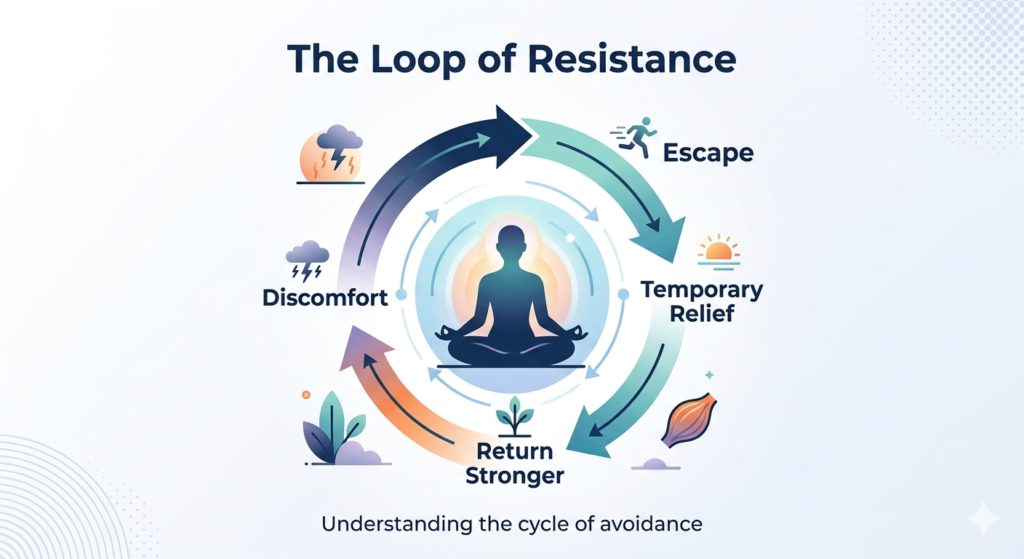
This mechanism can be understood as a resistance loop. You begin with awareness, discomfort arises, the mind creates distraction, you withdraw, and then familiarity returns. Over time, this loop becomes so automatic that you stop noticing it.
This pattern becomes even more visible in daily life, where staying in silence feels difficult, but engaging with constant stimulation feels effortless.
Why meditation triggers the strongest resistance
Meditation challenges the mind more directly than most activities. Instead of engaging with thoughts, you begin observing them. Instead of reacting, you remain still.
This shift reduces the mind’s control. And when control is threatened, the mind reacts.
It creates restlessness, doubt, and an urge to escape the practice. These reactions are often mistaken as signs that meditation is not working.
In truth, they indicate the exact opposite.
To understand how deeper awareness begins beyond this resistance, you can explore:
👉 https://eastsidewriters.com/the-gateway-to-super-consciousness-the-profound-spiritual-significance-of-the-medulla-oblongata/
The deeper connection between desire, habit, and identity
The same resistance appears in other areas of life. Whenever you try to break a habit, control a desire, or change a pattern, you encounter internal friction.
Desire is not just an impulse. It is a reinforced pattern built over time. The mind becomes attached to these patterns because they shape your sense of identity.
When you attempt to change them, it feels like losing a part of yourself. That is why even harmful behaviors can feel difficult to let go of. The resistance is not just emotional. It is structural.
You can relate this to how energy and behavioral patterns are discussed here:
👉 https://eastsidewriters.com/the-infamous-tantra-traditions-and-sexual-practices/
Ancient wisdom and modern science point to the same truth
Spiritual traditions have always acknowledged this resistance. The path of inner growth has never been described as easy, but as transformative.
Modern neuroscience offers a parallel explanation.
👉 Research shows that the brain is wired to favor familiar patterns.
The brain is wired to conserve energy and prefer familiar patterns. It avoids uncertainty because change requires effort and adaptation. Research in neuroplasticity shows how repeated behavior strengthens neural pathways, making change initially uncomfortable (you can externally link to a credible neuroscience or Harvard Health article here).
Both perspectives lead to the same understanding: discomfort is a natural part of growth.
For a deeper spiritual perspective on transcendence, you may explore:
👉 https://eastsidewriters.com/samadhi-leaving-your-body-at-your-own-will/
The turning point most people miss
Many people believe that growth should feel smooth. When they experience discomfort, they assume something is wrong and stop.
This is where most journeys end prematurely.
Discomfort is not a sign of failure. It is often the clearest indication that something is shifting. Meditation feels difficult because it interrupts deeply ingrained mental patterns. The same applies to any meaningful change in life.
The role of awareness and inner balance
As you begin to observe your thoughts without reacting to them, your internal state starts to change. Your energy becomes less scattered, and your mind gradually becomes clearer.
This process takes time. It is not immediate, and it is not always comfortable. But with consistency, the intensity of resistance begins to reduce.
To understand how inner energy systems influence awareness, explore:
👉 https://eastsidewriters.com/a-complete-guide-to-the-seven-chakras-of-our-body-and-the-process-to-activate-these-chakras/
How to move through resistance without forcing it
The first step is to recognize resistance when it appears. The moment you feel like quitting, pause instead of reacting immediately.
You do not need to push yourself aggressively. Reduce the intensity if needed, but maintain consistency. Even a few minutes of daily effort can create meaningful change.
Allow your thoughts to arise without trying to control them. Observation creates distance, and distance weakens the hold of patterns.
Most importantly, understand that discomfort is part of the process. It is not something to avoid, but something to move through.
Modern meditation is not merely relaxation but part of a much deeper science of awareness and higher consciousness.
A realization that changes everything
The mind does not resist everything. It resists only what has the potential to transform you.
This is why the most important changes in life often feel the most difficult at the beginning. The resistance you feel is directly linked to the depth of transformation that is possible.
Conclusion
The next time you sit to meditate or try to make a change and feel like quitting, pay attention to that moment.
That is not the point where you are failing. It is the point where something important is beginning.
If you can stay with that discomfort, even briefly, you start to see a separation between yourself and your thoughts. You begin to understand that you are not the noise in your mind, but the awareness behind it.
And once that realization begins, growth is no longer something you chase. It becomes something you experience.
#SelfAwareness, #Mindset, #PersonalGrowth, #MentalHealth, #Discipline, #InnerPeace, #Consciousness, #Meditation.



Pingback: Why Meditation Fails for Most People: The Hidden Struggle No One Talks About - Eastside Writers
Pingback: The Hidden Resistance to Meditation: What Your Mind Doesn’t Want You to Know - Eastside Writers
Pingback: Tips To Help You To Concentrate While In Meditation
Pingback: The Gateway To Super-Consciousness: The Profound Spiritual Significance Of The Medulla Oblongata - Eastside Writers
Pingback: Why You Can’t Sit in Silence—But Can Scroll for Hours to Satisfy Hidden Desires - Eastside Writers
Pingback: Why Saints Like Ramakrishna Warn Against Sexual Desires on the Path to Nirvana - Eastside Writers
Pingback: Nobody Listens Anymore — And That Is Why There Is No Peace Left In Our Homes - Eastside Writers
Pingback: Why Do Some Souls Recognize Each Other Instantly? — The Strange Mystery of Twin Flames, Cosmic Bonds, and Unfinished Connections Across Lifetimes - Eastside Writers
Pingback: Can Meditation Reveal Your Past, Future, and Hidden Potential? - Eastside Writers
Pingback: Why Sexual Thoughts Arise During Meditation: The Science, Psychology, and Spiritual Perspective - Eastside Writers
Pingback: Debunking Myths about Meditation and Spiritual Growth