
Humanity has entered an age of astonishing external advancement.
We can communicate across continents instantly, simulate intelligence through machines, access entire libraries from a handheld device, and alter the physical world with unprecedented precision. Civilization has mastered technology, economics, engineering, medicine, and information systems at levels unimaginable just a century ago.
And yet, inwardly, mankind appears increasingly unstable.
Anxiety, loneliness, psychological fatigue, addiction, emotional fragmentation, and existential emptiness continue rising even within materially developed societies. Human beings are more connected digitally than ever before, yet often feel profoundly disconnected from themselves.
This contradiction reveals something fundamental:

The Greatest Crisis of Modern Civilization Is Invisible
The modern crisis is not merely political, economic, or technological.
It is a crisis of consciousness.
Civilization has learned how to expand comfort but forgotten how to deepen awareness. We have trained the intellect while neglecting the inner architecture of the human being itself. The result is a society overflowing with stimulation yet starving for meaning.
A man today may understand finance, neuroscience, geopolitics, artificial intelligence, and quantum physics — yet remain inwardly restless, insecure, reactive, fearful, and psychologically dependent upon external validation.
This is because modern education largely informs the mind without transforming consciousness.
Ancient India approached the human being very differently.
The sages of the Upanishads did not begin by asking how society should function. They first asked a deeper question:
What exactly is man?
Their answer remains one of the boldest psychological and spiritual propositions ever made:
Beneath the constantly fluctuating personality lies a deeper dimension of awareness untouched by fear, comparison, ambition, insecurity, or social conditioning.
The Upanishadic declaration “Tat Tvam Asi” — Thou Art That — was not poetry alone. It was an exploration into the hidden depths of human consciousness.
And perhaps modern civilization is slowly rediscovering why that insight mattered.
Human Beings Have Become Externally Advanced but Internally Fragmented
The modern individual lives almost entirely outward.
From childhood onward, identity becomes constructed through comparison:
marks,
career,
money,
social approval,
physical attractiveness,
sexual validation,
followers,
status,
achievement.
The nervous system gradually becomes conditioned to seek value externally.
As a result, the mind loses contact with stillness.
This explains why so many people today feel psychologically exhausted despite appearing socially active. The average individual is continuously reacting:
scrolling,
consuming,
comparing,
performing,
desiring,
competing.
The mind rarely rests in simple awareness.
The greatest addiction of the modern age may therefore not be substances.
It may be a distraction.
Silence itself has become uncomfortable.
The moment external stimulation disappears, unresolved inner noise surfaces. This is why many people compulsively avoid solitude. Continuous engagement with screens, entertainment, opinions, or social interaction often functions less as fulfillment and more as psychological escape.
You have already explored this deeper phenomenon in our article discussing why human beings fear being alone with their thoughts. The inability to remain peacefully with oneself is often a symptom of inner fragmentation rather than loneliness itself.
Similarly, many modern psychological contradictions emerge from this same disconnected consciousness. Society simultaneously suppresses natural awareness while becoming obsessed with appearances, desire, comparison, sexuality, validation, and image construction.
This is precisely why external success frequently fails to produce inner fulfillment.
Pleasure and meaning are not identical.
Pleasure stimulates temporarily.
Meaning reorganizes consciousness.
A civilization obsessed only with stimulation eventually produces exhaustion.
Ancient Spiritual Traditions Treated Consciousness as a Science
One of the greatest misunderstandings surrounding spirituality today is the assumption that ancient contemplative traditions were based merely upon belief or ritualism.
In reality, many Indian spiritual systems approached consciousness with extraordinary psychological precision.
Meditation was never intended merely as relaxation therapy.
It was designed as a technology of perception.
The yogic sciences proposed that the human mind operates most of the time mechanically:
thoughts arise unconsciously,
desires emerge compulsively,
emotions react automatically,
behaviors repeat habitually.
Awareness interrupts this mechanical process.
The moment one begins observing thoughts without immediate identification, consciousness starts separating itself from psychological turbulence. This witnessing awareness forms the foundation of deeper meditation.
Ancient sages insisted that consciousness could be refined systematically through disciplined observation, silence, breath regulation, inward attention, and meditative stillness.
Modern neuroscience is now beginning to validate many of these insights. Studies increasingly suggest that meditation influences attention, emotional regulation, stress response, and neural plasticity.
The yogis discovered experientially what science is gradually examining analytically:
The mind changes according to what it repeatedly attends to.
Humanity often fails to recognize the soul beyond labels and appearances. This emotional reality is further explored in “Born This Way, Judged Anyway”, where we discuss the pain of being judged for one’s inherent identity.
Awareness Is the First Door to Higher Consciousness
Awareness is not identical to concentration.
Concentration narrows attention toward an object.
Awareness expands observation itself.
A concentrated mind may still remain ego-driven.
An aware mind begins observing the ego objectively.
This distinction changes everything.
Most individuals remain trapped inside their thoughts without realizing it. They assume every emotion, fear, insecurity, or desire represents their entire identity.
Meditative awareness gradually reveals something revolutionary:
thoughts are occurring within consciousness,
but consciousness itself is deeper than thought.
This insight becomes transformative.
One no longer remains merely lost inside psychological noise.
One begins witnessing it.
And from this witnessing emerges inner freedom.
This is why ancient spiritual systems emphasized self-observation before social reform. Unless the observer himself becomes conscious, his actions inevitably carry unconscious conflict outward into society.
Modern civilization attempts to solve external chaos while neglecting the internal fragmentation generating it.
The result is visible everywhere:
intelligence without wisdom,
freedom without discipline,
information without clarity,
power without consciousness.
Kriya Yoga and the Inner Mechanics of Transformation
Among India’s deeper spiritual traditions, Kriya Yoga occupies a particularly significant place because it emphasizes direct transformation of consciousness rather than blind belief.
The tradition gained worldwide recognition through Paramahansa Yogananda and his influential work Autobiography of a Yogi, which introduced millions to the possibility that spirituality could be approached experientially rather than dogmatically.
Kriya Yoga recognizes a profound relationship between breath, awareness, energy, and consciousness.
When the breath becomes disturbed, the mind becomes restless.
When awareness deepens, breathing patterns naturally transform.
Ancient yogis, therefore, developed systematic practices intended to calm internal turbulence and redirect awareness inward.
This inward movement was never considered escapism. It was regarded as evolution.
The purpose was not withdrawal from life, but liberation from unconscious psychological bondage.
Authentic spirituality is not anti-world.
It is anti-unconsciousness.
A spiritually aware individual may participate fully in worldly life while remaining inwardly centred. This is precisely why texts such as the Bhagavad Gita repeatedly emphasize conscious action rather than escapist renunciation.
Super Consciousness and the Hidden Potential Within Man
Modern culture often uses the term “super consciousness” vaguely, but classical yogic understanding approached it with remarkable depth.
Ordinary consciousness remains fragmented through constant division:
self and other,
success and failure,
pleasure and pain,
desire and fear.
Higher states of awareness gradually weaken this fragmentation.
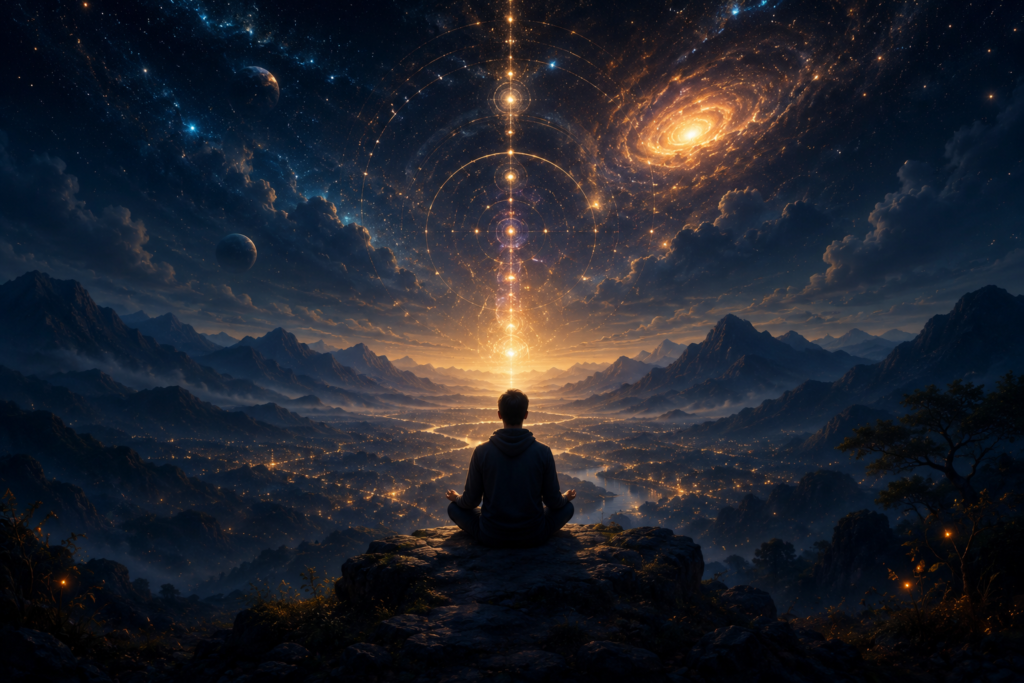
In deeper meditative states, practitioners often describe profound stillness, expanded perception, heightened clarity, compassion, fearlessness, and an unusual sense of interconnectedness.
Ancient mystics interpreted these not as fantasies, but as glimpses of a deeper layer of consciousness usually hidden beneath continuous mental noise.
The surface mind remains reactive and restless.
Deeper awareness remains silent and observant.
Meditation gradually shifts attention from surface turbulence toward deeper stillness.
This is why many people initially struggle with meditation. For perhaps the first time in their lives, they encounter the chaos of their own minds without distraction.
But persistence slowly reveals something extraordinary:
Peace is not manufactured externally.
It already exists beneath psychological noise.
Moksha: Freedom from Psychological Bondage
Perhaps no spiritual concept has been misunderstood more than Moksha.
Moksha is often interpreted only as liberation after death, but at a deeper level, it signifies liberation from compulsive identification with the egoic mind itself.
The ordinary individual remains psychologically imprisoned by fear, craving, comparison, insecurity, attachment, and endless mental agitation.
Moksha represents freedom from this unconscious bondage.
It does not imply withdrawal from existence.
Nor emotional numbness.
Rather, it signifies a state where consciousness no longer derives its identity entirely from temporary experiences.
The liberated mind can participate fully in life without becoming psychologically enslaved by it.
Such liberation naturally produces qualities desperately needed in modern civilization:
clarity,
equanimity,
fearlessness,
compassion,
self-mastery,
and profound inner stability.
Without inner evolution, external advancement becomes dangerous.
Intelligence without wisdom manipulates.
Power without consciousness corrupts.
Technology without self-awareness amplifies chaos.
Why Humanity Must Rediscover the Inner Sciences
The future of civilization may depend not merely upon technological advancement, but upon whether human consciousness evolves alongside technological power.
Artificial intelligence, biotechnology, virtual reality, neural engineering, and automation will continue transforming society rapidly. But unless the human mind itself becomes more conscious, humanity risks becoming externally advanced while inwardly unstable.
Ancient India offered humanity something extraordinarily important:
the understanding that consciousness itself can evolve.
Meditation,
awareness,
Kriya Yoga,
self-observation,
contemplative silence,
and higher states of consciousness may no longer remain merely spiritual interests.
In an overstimulated civilization, they may become psychological necessities.
Because ultimately, the greatest human struggle is not external.
It is the battle between unconsciousness and awareness.
Between mechanical living and conscious living.
Between endless distraction and inner clarity.
And perhaps the deepest insight of the sages still whispers quietly beneath the noise of modern civilization:
Man is not merely a biological organism carrying a restless mind.
There is something immeasurably greater concealed within him.
A deeper intelligence.
A silent awareness.
A hidden divinity.
Not something to be artificially manufactured,
But something is waiting patiently to be uncovered.
Explore more articles on meditation, awareness, psychology, and spirituality at Eastside Writers
Related Reading
You may also explore:
- Why do human beings fear being alone with their thoughts
- Medulla oblongata meditation and higher awareness
- The psychology of comparison, attraction, and validation
- Silence, consciousness, and inner transformation
- Kriya Yoga and the science of breath awareness
- Why modern overstimulation weakens awareness
External References
- National Center for Biotechnology Information – Meditation Research
- Vedanta Society – Understanding Consciousness and Vedanta
- Autobiography of a Yogi by Paramahansa Yogananda
#Consciousness, #Meditation, #KriyaYoga, #Awareness, #Spirituality, #HigherConsciousness, #Moksha, #SelfAwareness, #InnerTransformation, #Mindfulness, #Psychology, #HumanConsciousness, #SpiritualAwakening, #Yoga, #MentalClarity, #ModernSpirituality, #Vedanta, #SuperConsciousness, #MeditativeMind, #InnerPeace



Pingback: The Gateway To Super-Consciousness: The Profound Spiritual Significance Of The Medulla Oblongata - Eastside Writers
Pingback: Why Are We Secretly Curious About Other People’s Private Lives? (What It Reveals About You) - Eastside Writers
Pingback: Why Modern Homes Feel Emotionally Exhausted - Eastside Writers
Pingback: Why Do Some Souls Recognize Each Other Instantly? — The Strange Mystery of Twin Flames, Cosmic Bonds, and Unfinished Connections Across Lifetimes - Eastside Writers
Pingback: Why Some Spiritual Traditions Reject Clothing: The Hidden Psychology of Ego and Enlightenment - Eastside Writers
Pingback: Near-Death Experiences: Evidence or Illusion? The Chilling New Science That Changes Everything - Eastside Writers
Pingback: Can Meditation Reveal Your Past, Future, and Hidden Potential? – Eastside Writers
Pingback: The Life We Keep Waiting For: What Manifestation Really Means - Eastside Writers