
There are people who enter a room without announcing themselves, yet everyone somehow notices their presence.
They are not necessarily the most attractive. They are not the loudest voice in the conversation, nor are they trying to become the center of attention. And yet, when they leave, something of their presence lingers behind. Their calmness remains. Their words echo. Their silence itself seems to have communicated something meaningful.
Most people call this charisma.
Some call it confidence.
Others simply describe it as an unexplainable aura.
But what if none of these explanations are complete?
What if what we call magnetism is not merely a personality trait but the natural expression of a deeply ordered mind? What if psychology, neuroscience, and the world’s oldest spiritual traditions have all been observing the same phenomenon through different lenses?
The modern world has become exceptionally good at measuring the brain, yet remarkably poor at understanding consciousness.
Brain scans can reveal electrical activity. Neuroscience can explain how neurons communicate. Psychology can describe behavioral patterns with astonishing precision. Yet none of them can fully explain why two people with equal intelligence, similar education, and comparable life experiences leave entirely different impressions upon everyone they meet.
One person exhausts you after a ten-minute conversation.
Another leaves you feeling lighter without having said very much.
Somewhere between measurable biology and invisible consciousness lies a mystery that science is only beginning to explore while ancient wisdom has contemplated for thousands of years.
Perhaps the answers have never belonged exclusively to either world.
Perhaps they meet somewhere in between.

Your Brain Is Quietly Mapping Your Entire Reality
Every second of your life, your brain is performing an astonishing task.
It is filtering millions of bits of sensory information, comparing every new experience with memories accumulated over decades, identifying familiar patterns, predicting possible outcomes, and constructing what you believe to be reality. Neuroscientists often refer to this as predictive processing. Your brain is not simply observing the world—it is constantly interpreting it through the lens of everything it has previously learned.
Imagine walking through a dense forest for the first time.
At first, every tree appears identical. Every path seems uncertain. But after walking the same trail repeatedly, your brain develops an internal map. Eventually you no longer consciously search for landmarks. Your feet simply know where to step.
Your mind functions in exactly the same way.
Every conversation you have ever experienced, every disappointment, every success, every fear, every relationship, every emotional wound leaves behind a subtle imprint. These accumulated impressions become mental maps that guide your reactions long before conscious thought enters the picture.
This process is essential for survival.
Without it, every ordinary task would require enormous effort.
But there is a hidden cost.
Over time, the map slowly becomes more convincing than the territory itself.
You stop meeting people as they truly are.
Instead, you meet your accumulated expectations of them.
You stop responding to the present moment.
You respond to memories.
This is where modern neuroscience and ancient spirituality begin to shake hands.
Thousands of years before the discovery of neurons, yogic philosophy described Samskaras—subtle mental impressions left by every thought, action, emotion, and experience. These impressions gradually shape perception until human beings no longer experience reality directly. They experience reality through conditioning.
Modern neuroscience describes neural pathways.
Ancient sages described Samskaras.
Different language.
Remarkably similar observation.
The deeper question therefore, is not merely how the brain works.
The deeper question is this:
Can these mental maps be transformed?
The answer, according to both neuroscience and authentic meditation traditions, is yes.
The Prison Built by Constant Thinking
Most people assume thinking is the highest function of the human mind.
In truth, thinking is simply one tool among many.
Imagine sitting beside a perfectly still lake on a quiet morning. When its waters are calm, every detail beneath the surface becomes visible—the smooth stones resting at the bottom, the fish moving effortlessly through the water, and the mountains reflected with remarkable clarity.
But the moment the surface is disturbed, those same details disappear beneath countless ripples. The landscape has not changed; only the condition of the water has. Our minds function in much the same way.
Most of us spend our lives in a state of constant mental activity. Thoughts flow endlessly from one concern to another—planning the future, replaying the past, comparing ourselves with others, imagining conversations that may never happen, worrying about outcomes we cannot control, and silently judging almost everything we experience.
This uninterrupted stream of thinking creates an inner turbulence that we eventually mistake for intelligence. Yet a mind that is constantly busy is not necessarily a mind that sees clearly, just as a computer operating at full capacity is not always solving the right problem.
Much of the stress we attribute to the outside world is, in reality, generated by the relentless commentary within our own minds. The ego sustains itself through this continuous narrative—telling us who we are, how others perceive us, what we lack, what we fear losing, and what must happen before we can finally feel complete.
Because this internal dialogue rarely falls silent, we become so absorbed in its noise that we overlook something far more profound. Beneath the endless movement of thought lies a deeper awareness—calm, still, and untouched by the fluctuations of the mind. It is only when the turbulence begins to settle that this higher dimension of consciousness can finally be experienced.
Meditation Is Not Escaping Thought
Many people approach meditation hoping to reduce anxiety, improve focus, or sleep better.
These are valuable benefits.
But they are only the outermost layer.
Authentic meditation was never intended merely as stress relief.
It is a profound exploration of consciousness itself.
When practiced consistently, meditation does something extraordinary.
Instead of feeding existing mental pathways, it gradually weakens them.
Instead of strengthening habitual reactions, it creates space before reaction occurs.
Instead of allowing old conditioning to dictate every decision, it introduces freedom.
At first, this freedom lasts only a few seconds.
Then minutes.
Eventually it becomes a way of living.
Modern researchers refer to this process as neuroplasticity—the brain’s remarkable ability to reorganize itself throughout life.
Ancient yogis described the same transformation differently.
They spoke of dissolving Samskaras.
Burning accumulated karmic impressions.
Purifying the mind until it reflects consciousness as clearly as a still lake reflects the moon.
Again, two languages.
One reality.
Meditation is not adding something new to your mind.
It is removing everything that prevents you from seeing clearly.
That distinction changes everything.
Beyond the Conscious and the Subconscious
Most discussions about the mind usually end with two familiar categories: the conscious mind and the subconscious mind. The conscious mind analyzes, reasons, plans, and makes deliberate decisions, while the subconscious quietly stores our memories, habits, emotions, and deeply conditioned patterns that influence everyday life. Together, they explain much of human behaviour, but they may not explain the whole of human consciousness.
Ancient spiritual traditions describe a third dimension known as the superconscious mind. It is neither the thinking conscious mind nor the conditioned subconscious, but a higher state of awareness that exists beyond both. In this state, consciousness is no longer dominated by the constant chatter of thoughts or the limitations of past conditioning.
Many of humanity’s greatest insights seem to arise from this deeper level of awareness. Creative breakthroughs, profound intuition, scientific discoveries, and artistic masterpieces often emerge during moments of stillness rather than relentless thinking. Great thinkers and mystics alike have described these experiences as insights that were received rather than consciously manufactured.
Perhaps these moments are not extraordinary at all. Perhaps they become available whenever the noise of ordinary thinking begins to settle. The greatest discoveries of our lives may not come from thinking harder, but from becoming quiet enough to hear the wisdom that has always existed beneath the surface of the mind.
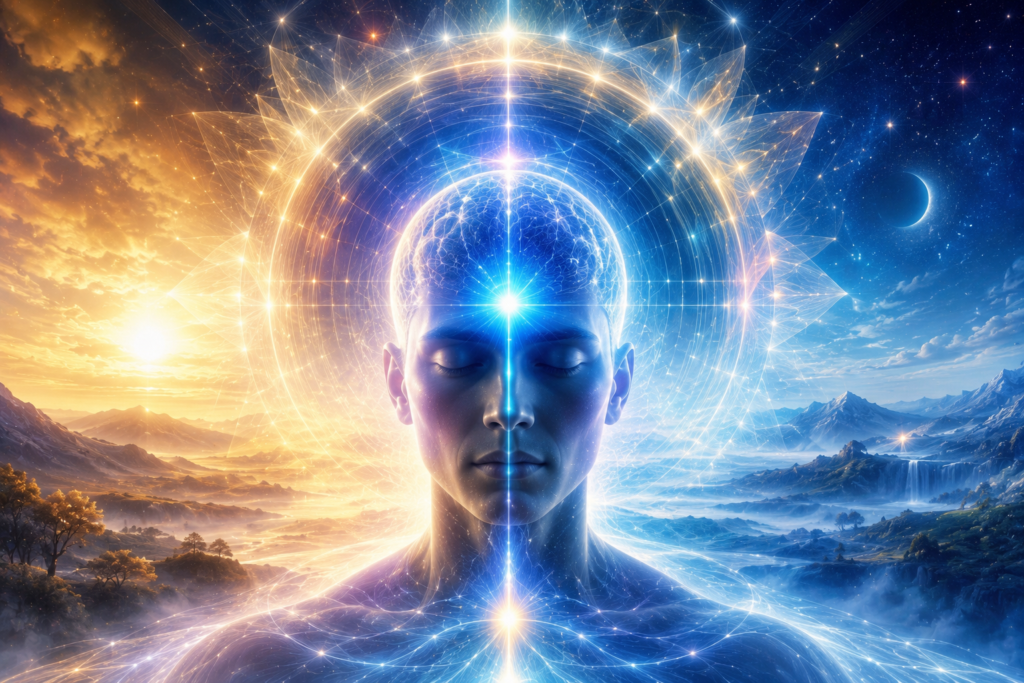
The Awakening of Kutastha Consciousness
Ancient yogic traditions describe a state of awareness that exists beyond the restless activity of the ordinary mind. They call it Kutastha Chaitanya—the changeless consciousness that quietly witnesses every thought, emotion, memory, and experience without becoming entangled in them.
Different spiritual traditions have given this realization different names.
In Christianity, it is often referred to as Christ Consciousness. In Buddhism, it is the awakened Buddha Nature. In Vedanta, it is the realization of the Self. The language changes with culture and time, yet the experience itself points toward the same destination: a consciousness no longer imprisoned by the constant fluctuations of the mind.
Contrary to popular belief, awakening this higher state does not require withdrawing from life.
It requires becoming fully present within it.
Most of us spend our lives identifying with every thought that passes through the mind. We become angry because an angry thought appeared. We become anxious because fear knocked at the door of our consciousness. We become proud when praise arrives and devastated when criticism follows. We forget that thoughts are events occurring within consciousness, not the consciousness itself.
Meditation slowly restores this forgotten distinction.
The more we observe our thoughts without reacting to them, the weaker their authority becomes. We discover a silent observer behind the mind—calm, unchanging, and astonishingly peaceful. That silent awareness is not something we create through meditation. It has always been present. Meditation merely removes the noise that prevented us from noticing it.
This realization marks one of the greatest turning points in spiritual growth.
Instead of living from the surface of the mind, we begin living from the depth of consciousness itself.
Karma Is More Than Cause and Effect
Whenever karma is discussed, it is often reduced to a simple equation: do good and good returns; do harm and harm eventually follows.
While there is truth in that understanding, it barely scratches the surface.
Every thought we repeatedly entertain strengthens a particular pathway within the brain. Every emotional reaction reinforces certain neural circuits. Over months and years, these reactions become habits. Habits become personality, and personality quietly shapes destiny.
Ancient yogis observed the same process long before modern neuroscience existed.
They taught that every action, every intention, and every emotion leaves behind a subtle impression known as a Samskara. These impressions accumulate throughout life, influencing perception long after the original experience has passed. Karma, therefore, is not merely something waiting in the future. It is actively shaping how we experience the present.
This understanding changes everything.
Many people believe they are reacting to reality when, in truth, they are reacting to accumulated conditioning. Two individuals can face the same situation and interpret it completely differently because their karmic impressions are different. Reality has not changed. The lens through which they observe it has.
Meditation gradually cleans this lens.
As old impressions lose their grip, our responses become less automatic and more conscious. Instead of living from inherited patterns, we begin responding from wisdom rather than conditioning.
Perhaps this is why every genuine spiritual path places such extraordinary emphasis on self-awareness.
Without awareness, karma continues repeating itself.
With awareness, karma begins to dissolve.
Why Spiritually Evolved People Feel Different
Have you ever met someone who immediately made you feel comfortable without trying to impress you?
They listened without interrupting. They spoke without arrogance. Their presence carried no hidden agenda. You found yourself relaxing in their company without knowing exactly why.
We often attribute this feeling to personality.
Yet personality alone cannot explain it.
The human nervous system is constantly responding to the emotional state of those around us. A restless mind unconsciously communicates restlessness. An anxious person often spreads anxiety without speaking about it. Likewise, a deeply peaceful individual naturally invites calmness into every interaction.
People sense coherence before they analyze words.
This is one reason spiritually mature individuals appear magnetic.
Their attention is no longer consumed by endless self-concern. They are not silently calculating how they are being perceived, comparing themselves with others, or rehearsing what to say next. Their awareness is available because it is no longer trapped within the walls of the ego.
When you speak to such a person, you feel heard.
Not because they have mastered communication techniques, but because they are genuinely present.
Presence has a quality that cannot be manufactured.
No amount of rehearsed confidence can imitate the quiet strength of a mind that has discovered inner stillness.
True magnetism, then, is not something you acquire.
It is something that naturally appears when inner conflict begins to disappear.
The Forgotten Power of Inner Silence
Modern civilization has convinced us that progress always requires doing more.
More information.
More productivity.
More goals.
More stimulation.
Rarely are we encouraged to cultivate silence.
Yet silence has always been regarded as one of humanity’s greatest teachers.
Silence is not merely the absence of sound.
It is the absence of unnecessary psychological noise.
Within silence, perception sharpens. Intuition becomes clearer. Creativity begins flowing without force. Compassion arises without effort. Problems that once seemed impossible often reveal surprisingly simple solutions because the mind is no longer struggling against itself.
Many of history’s greatest spiritual masters withdrew into silence not because they wished to escape the world but because they understood something the modern mind has largely forgotten.
The deepest intelligence reveals itself when the constant chatter finally subsides.
This explains why genuine meditation feels profoundly different from ordinary relaxation.
Relaxation refreshes the body.
Silence transforms consciousness.
Science and Spirituality Are Beginning to Meet
For centuries, science and spirituality appeared to stand on opposite sides of human understanding.
One explored matter.
The other explored consciousness.
Today that separation is becoming increasingly difficult to maintain.
Neuroscience confirms that sustained meditation physically reshapes the brain. Psychology acknowledges that attention determines experience. Studies on mindfulness demonstrate measurable improvements in emotional regulation, empathy, resilience, and overall well-being.
Ancient spiritual traditions would not find these discoveries surprising.
They simply began from the inside instead of the outside.
Science asks, “What changes inside the brain?”
Spirituality asks, “Who is aware of the brain?”
One investigates the instrument.
The other investigates the musician.
Neither perspective is complete without the other.
Perhaps humanity’s next great leap will not come from choosing between science and spirituality but from allowing each to illuminate the other.
Truth does not fear investigation.
It welcomes it.
Becoming the Person You Were Always Meant to Be
Many people spend their lives trying to become more attractive, more successful, more respected, or more influential.
There is nothing inherently wrong with these aspirations.
The difficulty begins when we believe these external achievements will finally bring inner peace.
History repeatedly demonstrates otherwise.
Some of the world’s most accomplished individuals remain deeply restless because external success cannot heal internal fragmentation.
The great spiritual traditions have always suggested the opposite approach.
Instead of chasing magnetism, cultivate inner harmony.
Instead of seeking admiration, seek understanding.
Instead of attempting to control every circumstance, learn to master your own mind.
Everything else begins following naturally.
A calm mind thinks more clearly.
A clear mind makes wiser decisions.
Wise decisions create healthier relationships.
Healthier relationships contribute to meaningful lives.
Meaningful lives inspire others without ever trying to do so.
Magnetism is therefore not the destination.
It is the by-product.
The Final Reflection
Perhaps the greatest misunderstanding of our age is the belief that consciousness is produced entirely by the brain.
The brain is undoubtedly extraordinary. It maps experience, forms memories, predicts outcomes, and enables remarkable intelligence. Yet the ancient sages gently suggested that behind every thought exists something even more extraordinary—the silent awareness capable of observing the mind itself.
Whether we call it the superconscious mind, Christ Consciousness, Kutastha Chaitanya, Buddha Nature, or simply awakened awareness matters far less than experiencing it.
Names belong to philosophy.
Experience belongs to transformation.
As the mind becomes quieter through sincere meditation, old conditioning gradually loosens its grip. Karmic impressions begin losing their power. Perception becomes clearer. Compassion replaces comparison. Presence replaces performance. Slowly, almost imperceptibly, a different way of living emerges.
This is the magnetism that cannot be taught in a seminar or purchased through self-help formulas.
It cannot be imitated because it is not a technique.
It is the quiet radiance of a human being who has discovered that true power does not come from controlling others, but from mastering oneself.
In the end, perhaps the journey of meditation has never been about escaping the world.
It has always been about seeing it—and ourselves—as we truly are.
When that happens, the search for magnetism quietly ends.
For you no longer strive to attract light.
You become a source of it.
Further Reading
Continue Your Journey
The Silent Power of Self-Awareness — Learn why observing your thoughts is the first step toward inner transformation.
The Art of Quieting the Mind — Explore how silence becomes the foundation of clarity and emotional balance.
Why God Is Silent When We Pray (if this is already published on Eastside Writers)
Understand how silence can become one of the greatest teachers on the spiritual path.
The Ego: Friend or Greatest Obstacle? (if already published)
Learn how the ego shapes perception and why transcending it opens the door to higher consciousness.
Why Do We Take Birth? — A deeper spiritual exploration of karma, reincarnation, and the purpose of human existence.
Frequently Asked Questions
1. What is Kutastha (Christ Consciousness)?
Kutastha (Christ Consciousness) is the unchanging state of higher awareness described in yogic philosophy as the silent observer beyond the thinking mind. Often compared with Christ Consciousness in Christian mysticism, it represents a state of inner stillness, wisdom, compassion, and spiritual awakening that can be cultivated through deep meditation and self-awareness.
2. Is Kutastha Consciousness the same as Christ Consciousness?
Many spiritual teachers believe they refer to the same universal state of divine awareness, although the terminology differs across traditions. In yoga, it is called Kutastha Chaitanya, while Christianity often refers to it as Christ Consciousness. Both describe a state of awakened consciousness rooted in love, compassion, and unity rather than ego.
3. How does meditation help awaken higher consciousness?
Regular meditation gradually quiets the constant activity of the conscious mind. As mental distractions and conditioned thought patterns begin to settle, practitioners become more aware of the deeper levels of consciousness that lie beyond ordinary thinking. This inner stillness is considered the foundation for experiencing higher awareness.
4. Can neuroscience explain spiritual experiences?
Neuroscience can explain many changes that occur in the brain during meditation, including improved focus, emotional regulation, and neuroplasticity. However, whether these changes fully explain spiritual experiences remains an open question. Many researchers and spiritual traditions view the brain as the instrument through which consciousness is expressed rather than its ultimate source.
5. What is brain mapping, and how does it influence our behaviour?
Brain mapping refers to the way the brain continuously forms neural pathways based on our experiences, memories, emotions, and repeated behaviours. These mental patterns influence how we perceive people, respond to situations, and make decisions. Meditation helps create healthier neural pathways by reducing automatic reactions and increasing conscious awareness.
6. What are Samskaras in yogic philosophy?
Samskaras are subtle mental impressions created by every thought, emotion, and action. Over time, these impressions shape our habits, beliefs, and personality. According to yogic philosophy, meditation gradually weakens these conditioned patterns, allowing us to respond to life with greater freedom and awareness.
7. Why do spiritually evolved people often appear magnetic?
People with a high level of self-awareness and inner peace naturally create a sense of comfort and trust in those around them. Their presence is less influenced by ego, comparison, or emotional turbulence, allowing others to feel genuinely seen and understood. This quiet authenticity is often experienced as true human magnetism.
8. Can anyone develop true human magnetism?
Yes. Authentic magnetism is not a personality trait reserved for a select few. It develops naturally as we cultivate self-awareness, emotional balance, compassion, and inner silence through practices such as meditation, mindfulness, and conscious living.
9. Is karma only about actions?
No. In many Eastern philosophies, karma includes not only our actions but also our intentions, thoughts, and emotional patterns. These create mental impressions that influence future behaviour and perception. Developing awareness through meditation helps reduce the influence of these conditioned patterns.
10. What is the relationship between higher consciousness and inner peace?
Higher consciousness enables us to observe thoughts and emotions without becoming controlled by them. As identification with the restless mind gradually decreases, inner peace becomes a natural state rather than a temporary emotional experience. This is why many spiritual traditions regard higher consciousness as the foundation of lasting happiness.
#KutasthaConsciousness #ChristConsciousness #HigherConsciousness #HumanMagnetism #SpiritualAwakening #Meditation #SuperconsciousMind #BrainMapping #Neuroscience #Mindfulness #Karma #SelfAwareness #SpiritualGrowth #PersonalGrowth #InnerPeace #ConsciousLiving #AwakenYourMind #MeditationJourney #EastsideWriters #TransformYourMind



Pingback: Why Understanding Yourself Is the Hardest Journey in Life – Eastside Writers
Pingback: How to Find Your True Self: A Simple Path to Higher Consciousness – Eastside Writers
Pingback: Why Do We Take Birth Again and Again? A Deep Dive into Karma, Maya, and Moksha - Eastside Writers