
Death is the one journey every human being must take.
Yet despite thousands of years of philosophy, religion, and science, one question continues to haunt us: what actually happens after the final breath?
Modern medicine can tell us when the heart stops. Neuroscience can study electrical activity inside the brain. But neither can fully answer what happens to consciousness itself.
Ancient Hindu wisdom offers a fascinating perspective.
According to the Garuda Purana, death is not an ending. It is a transition.
And the first thirteen days after death may be among the most important stages of the soul’s journey.
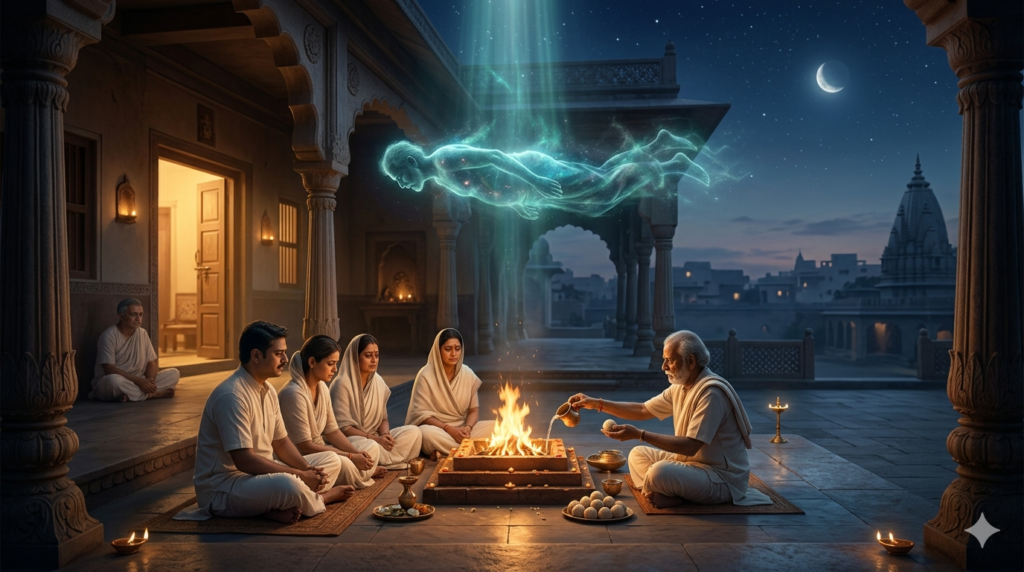
Why Hindu Tradition Places Such Importance on 13 Days
Most cultures focus on the funeral.
Hindu philosophy focuses on what comes after.
The Garuda Purana describes the soul’s transition as a gradual process rather than an instant event. Just as a traveler needs time to adjust to a new land, the soul is believed to need time to adjust to a new state of existence.
This is why traditional Hindu families observe thirteen days of mourning, prayer, remembrance, and ritual.
The ceremonies are not merely cultural customs.
They are intended to support the soul’s onward journey.
Readers who are new to this subject may first want to explore our article on Life After Death: What Ancient Hindu Wisdom Reveals About Consciousness Beyond the Body, where we examine the broader question of consciousness after physical death.
Days 1–3: The Soul Remains Close
According to the Garuda Purana, the soul does not immediately depart for another realm.
Instead, it remains closely connected to its former life.
The scriptures describe a period of adjustment during which the soul witnesses loved ones grieving, observes funeral preparations, and gradually begins to understand that physical life has ended.
This description explains why Hindu traditions place such importance on maintaining a peaceful atmosphere during mourning.
Family members are encouraged to pray.
To remember.
To bless.
Not because the departed is gone, but because the departed may still be near.
Timeline
Physical Death
↓
Separation from the Body
↓
Awareness of Family and Surroundings
↓
Gradual Acceptance
Interestingly, many modern Near-Death Experience reports include accounts of people describing events around them while they were clinically unconscious.
Such reports do not prove ancient scriptures correct, but they continue to raise fascinating questions about the nature of consciousness.
Why Cremation Holds Such Spiritual Significance
One of the most important moments in Hindu funeral traditions is cremation.
From a spiritual perspective, cremation is not simply the disposal of a body.
It is an acknowledgement.
The body has completed its purpose.
The journey continues.
The Bhagavad Gita beautifully expresses this idea through the metaphor of changing garments. Just as a person discards worn-out clothes and puts on new ones, the soul leaves behind an old body and continues onward.
Days 4–6: The Transitional State Begins
As the initial shock fades, the scriptures describe the soul entering a more subtle phase.
The body has been left behind.
The memories have not.
Attachments, desires, emotions, and impressions are believed to remain active during this period.
The Garuda Purana presents this stage as a gradual loosening of earthly bonds.
Not a sudden break.
A gradual release.
There is something surprisingly human about this description.
Even the living rarely let go overnight.
Readers interested in the deeper layers of consciousness may also enjoy Turiya: The Forgotten State of Consciousness Modern Seekers Are Rediscovering, which explores states of awareness beyond ordinary waking experience.
Days 7–9: The Mystery of Pinda Daan
Few Hindu rituals generate as much curiosity as Pinda Daan.
Rice offerings are made with prayers for the departed soul.
According to traditional interpretations, these offerings help support the soul during its onward journey.
Some view this literally.
Others view it symbolically.
Either way, the message remains powerful.
Love continues beyond death.
Gratitude continues beyond death.
Responsibility continues beyond death.
The deeper relationship between karma, memory, and the soul’s journey is explored in Akashic Records, Karma, and the Spiritual Nakedness of the Soul.
Timeline
Prayer
↓
Remembrance
↓
Offering
↓
Blessing
↓
Release
Day 10: A Turning Point
The tenth day is often regarded as a significant milestone.
Many Hindu traditions view it as the point where the soul’s transition reaches a new stage of completion.
For the family, it often marks a subtle emotional shift as well.
The shock begins to soften.
Memories begin to replace disbelief.
Grief begins its transformation into remembrance.
Across cultures, people frequently report vivid dreams, unusual coincidences, or moments of unexpected connection during this phase of mourning.
Whether spiritual or psychological, such experiences continue to shape humanity’s understanding of loss.
Days 11–12: The Role of Karma
No Hindu discussion of death is complete without karma.
The Garuda Purana teaches that every action leaves an imprint.
Every intention matters.
Every choice contributes to the ongoing evolution of consciousness.
This idea is symbolized through Chitragupta, the cosmic recorder of deeds, and Yama, the guardian of universal order.
Whether understood literally or symbolically, the message remains the same.
Nothing is lost.
Nothing is forgotten.
Everything contributes to the soul’s journey.
Readers interested in this process should also explore The Grand Timeline: Step-by-Step Mechanical Guide to How Reincarnation Works, which examines how karmic impressions influence future births.
Day 13: The Ceremony of Release
The thirteenth day is known in many traditions as Terahvin.
This marks the formal conclusion of the mourning period.
Family and friends gather.
Prayers are offered.
Charitable acts are performed.
Blessings are given.
The emotional focus gradually shifts from grief toward gratitude.
According to traditional teachings, this is the moment when the soul fully embarks upon the next stage of its journey.
For some souls, that journey may eventually lead toward reincarnation, while for others, Hindu philosophy teaches that the ultimate destination is Moksha—the liberation from the cycle of birth and death itself.
The living let go.
The soul moves forward.
Life continues on both sides of the mystery.
What Modern Research Is Beginning to Explore
Modern science has not confirmed the detailed afterlife descriptions found in Hindu scriptures.
However, researchers continue to investigate Near-Death Experiences, terminal lucidity, and consciousness during cardiac arrest.
These studies do not validate ancient texts.
Nor do they dismiss them.
Instead, they invite further exploration into questions humanity has been asking for thousands of years.

The soul’s journey after death is only one part of the larger picture. To understand why the soul returns to Earth, read our article Why Do We Take Birth Again and Again?
The Deeper Lesson Hidden Within the 13 Days
Perhaps the real significance of the thirteen-day tradition has little to do with death itself.
It may have everything to do with life.
The Garuda Purana reminds us that our actions matter. Our relationships matter. The way we live today shapes the journey we undertake tomorrow.
Whether one interprets these teachings literally, spiritually, or symbolically, they encourage a more conscious way of living.
And that may be the most important lesson of all.
If this topic resonates with you, continue your journey through our related articles:
- Life After Death: What Ancient Hindu Wisdom Reveals About Consciousness Beyond the Body
- The Grand Timeline: Step-by-Step Mechanical Guide to How Reincarnation Works
- Akashic Records, Karma, and the Spiritual Nakedness of the Soul
- Turiya: The Forgotten State of Consciousness Modern Seekers Are Rediscovering
- Moksha: The Final Destination of Every Soul
Because understanding death has always been one of humanity’s most profound ways of understanding life.
#LifeAfterDeath #First13DaysAfterDeath #GarudaPurana #HinduWisdom #SoulJourney #Consciousness #Reincarnation #Karma #Moksha #Afterlife #HinduPhilosophy #Spirituality #PindaDaan #NearDeathExperience #AncientWisdom #SpiritualGrowth #ConsciousLiving #DeathAndRebirth #SoulEvolution #EastsideWriters


Pingback: What Happens After Death? Exploring Consciousness, Reincarnation, and Life Beyond Death - Eastside Writers
Pingback: Understanding Reincarnation and Beyond - The Myths and Facts.
Pingback: Why Humans Fear Death: The Secret Reason We Chase Success, Love, and Legacy - Eastside Writers