
In almost every civilization, clothing has symbolized identity, status, power, culture, morality, and social belonging. Human beings do not merely wear clothes to protect the body; they wear them to construct a psychological self. What we wear silently tells the world who we are, where we belong, what we possess, and often, what we fear.
Yet across history, some of the world’s deepest spiritual traditions moved in the exact opposite direction.
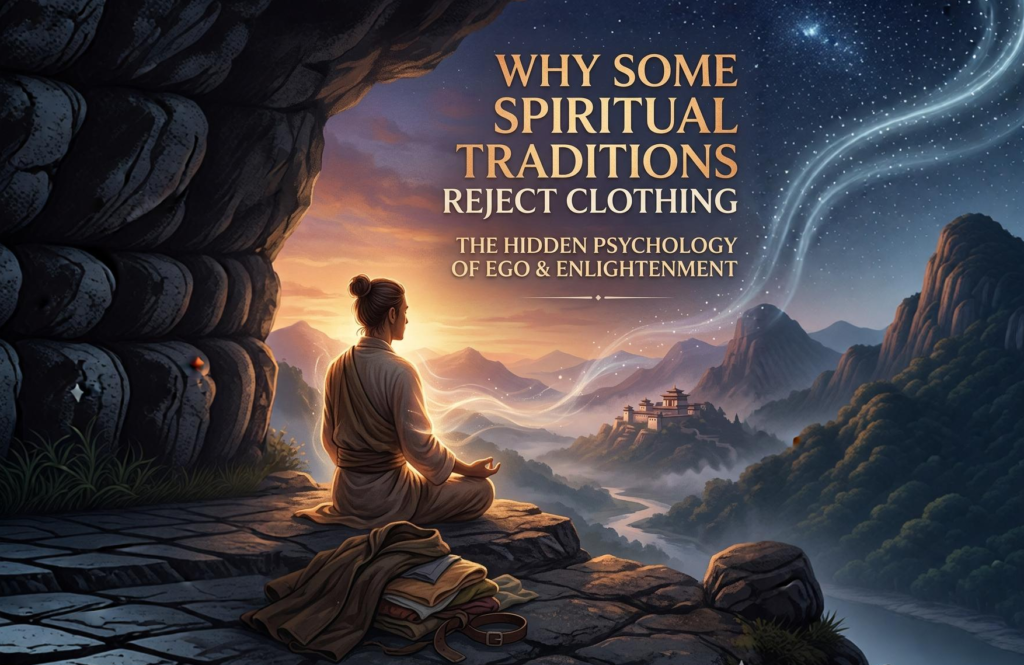
Certain monks, mystics, ascetics, sages, and seekers voluntarily abandoned clothing altogether—not out of rebellion or sensuality, but as a radical spiritual statement. To the modern mind, this can appear shocking, irrational, or primitive. But beneath the surface lies a profound psychological and philosophical framework connected to ego dissolution, silence, inner freedom, and the pursuit of higher consciousness.
Perhaps nakedness, in these traditions, was never about the body at all.
Perhaps it was about removing everything false.
Jain Digambara Philosophy and Complete Detachment
One of the most striking examples emerges from the ancient Digambara tradition of Jainism. The word “Digambara” literally means “clothed by the sky.” Digambara monks renounce not only possessions and material identity, but even clothing itself, seeing attachment to garments as another subtle form of ego and ownership.
Their path is rooted in radical detachment, non-violence, austerity, and liberation from worldly conditioning. According to Encyclopaedia Britannica’s overview of Digambara Jainism, nakedness in this tradition symbolizes freedom from material dependence and attachment.
This ancient philosophy mirrors many modern spiritual discussions surrounding simplicity, silence, and inward awareness explored in our article on When Peace Begins To Isolate You: The Silent Paradox of Meditation, Solitude and Human Transformation.
The desire to strip away psychological conditioning and social identities parallels the ancient search for Turiya, a state of awareness believed to exist beyond the ego itself.
The Psychology of Ego and Identity
Modern psychology strongly supports the idea that identity is deeply tied to external presentation. The human ego survives through layers of identification. We identify with our appearance, profession, beauty, wealth, religion, status, and social image.
Clothing becomes one of the strongest external extensions of this psychological self.
Luxury brands create identity.
Uniforms create hierarchy.
Fashion creates comparison.
Appearance creates insecurity.
The ego thrives through visible distinction.
But when all symbols are removed, something psychologically uncomfortable begins to happen. A person is forced to confront themselves without decoration, social armor, or manufactured identity. Vulnerability appears. Self-consciousness surfaces. Shame conditioning emerges from the subconscious.
Research and discussions from Psychology Today frequently explore how body image, vulnerability, identity, and social comparison influence human suffering and emotional insecurity.
And this is precisely why certain spiritual traditions viewed symbolic nakedness as psychologically transformative.
Not because the body was sacred.
But because the ego was deceptive.
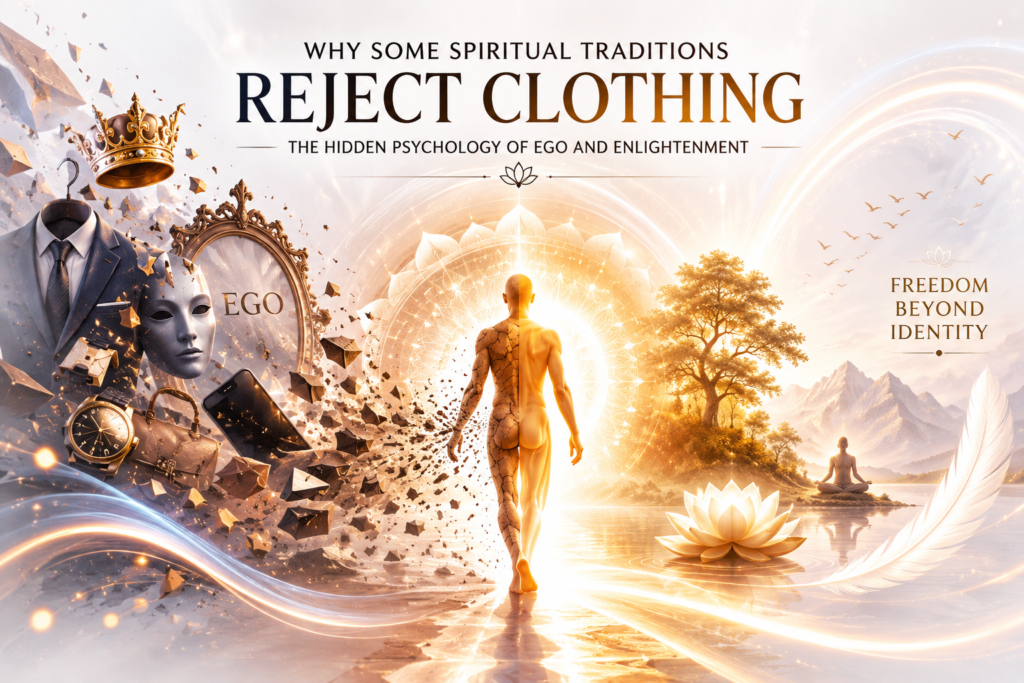
Symbolic Nakedness and the Dissolution of Ego
One of the deepest misunderstandings about spiritual nakedness is assuming it is purely physical. In reality, many traditions treated nakedness symbolically.
The real objective was the removal of false identity.
A person may remain fully clothed yet still be psychologically trapped by ego, insecurity, validation addiction, materialism, and constant comparison. Another person may live simply and inwardly free.
This deeper idea closely aligns with spiritual teachings discussed in our exploration of The Gateway To Super-Consciousness: The Profound Spiritual Significance Of The Medulla Oblongata, where higher awareness is described as emerging through inner stillness rather than external accumulation.
The spiritual seeker was not merely removing fabric.
They were attempting to remove illusion.
Silence, Solitude, and Sensory Reduction
This inward movement is central to nearly every authentic meditative path.
In deep silence, consciousness slowly detaches from appearance-based identity. Breath becomes more important than image. Presence becomes more important than performance.
This is why many ascetic traditions embraced solitude and minimalism.
Solitude removes constant psychological stimulation.
Silence removes social performance.
Minimalism removes distraction.
Sensory reduction weakens mental noise.
And symbolic nakedness removes one of the final layers of social identity.
Together, they create conditions for radical inner observation.
The connection between solitude and spiritual awakening has also been deeply explored in our article Solitude vs Loneliness: Understanding the Difference Between Isolation and Inner Peace.
Meditation, Body Awareness, and Super-Consciousness
Contemporary neuroscience has begun studying how meditation alters self-awareness and ego-centered thinking. Research published by Harvard Medical School and the National Institutes of Health continues exploring how deep meditation affects emotional regulation, identity perception, and self-referential thought patterns.
Ancient seekers described similar experiences using different language:
moksha,
nirvana,
samadhi,
ego dissolution,
super-consciousness.
Perhaps the vocabulary changed across centuries, but the inner experience remained remarkably similar.
This also connects powerfully with practices surrounding Kundalini awakening and expanded consciousness discussed in Learning Tantra Meditation To Awaken Kundalini In You.
Spiritual Minimalism and Returning to Nature
Many traditions viewed nakedness as a symbolic return to nature itself.
Before civilization, before fashion, before social hierarchy, human beings existed directly within nature. The spiritual seeker therefore attempted to psychologically return to simplicity and existential honesty.
This explains why spiritual minimalism repeatedly appears across cultures:
A silent cave.
A forest hermitage.
An empty room.
A simple robe.
A detached life.
The less external noise surrounding consciousness, the more clearly inner reality can be perceived.
In many ways, modern individuals suffer not from lack—but from overstimulation.
Too much information.
Too much identity.
Too much comparison.
Too much noise.
And perhaps this is why simplicity feels spiritually powerful.
What Spiritual Nakedness Truly Represents
Modern culture continuously encourages people to construct identity externally. Social media intensifies image-consciousness to unprecedented levels. Human worth becomes linked to visibility, attractiveness, wealth display, and endless performance.
The result is psychological exhaustion.
People increasingly feel disconnected from themselves because they are perpetually managing external identity.
This is why ancient ascetic traditions continue to fascinate modern minds—not because everyone wishes to imitate them literally, but because they reveal how much human suffering may originate from attachment to identity itself.
In the end, the deeper teaching was never about abandoning clothing.
It was about abandoning illusion.
And perhaps this is the hidden psychology behind why some spiritual traditions embraced nakedness—not as rebellion or obscenity, but as an extreme symbolic act of dissolving everything artificial between the self and existence itself.
The real question is not why some mystics abandoned clothing.
The real question is:
How much of what we call “self” is merely something we have been taught to wear?
The fear of being psychologically exposed often mirrors a deeper human fear of losing identity itself, which is why questions about consciousness and existence beyond death continue to fascinate seekers across cultures.
Conclusion: The Real Meaning Behind Spiritual Nakedness
The deeper purpose behind spiritual nakedness was never about the body itself. It was about removing the layers of identity that human beings become attached to over time—status, appearance, possessions, social approval, and ego.
Ancient spiritual traditions understood that much of human suffering begins when people start defining themselves through external things. The more the ego seeks validation, comparison, and recognition, the more restless the mind becomes.
This is why many mystics embraced silence, solitude, minimalism, and detachment. They believed inner peace could only emerge when external distractions became weaker. Symbolic nakedness therefore represented complete psychological honesty—a state where nothing artificial remained between the individual and existence.
In today’s world, this philosophy feels more relevant than ever. Modern life constantly pressures people to perform, impress, and maintain carefully constructed identities. Social media, materialism, and endless comparison have made the human mind noisier than ever before.
Perhaps this is why ancient ascetic traditions continue to fascinate modern society.
Because beneath all their extreme symbolism lies a timeless truth:
Real freedom may begin the moment we stop seeking ourselves in the external world and start discovering ourselves within.
Related Reads
- Eastside Writers – When Peace Begins To Isolate You: The Silent Paradox of Meditation, Solitude and Human Transformation
- Eastside Writers – Solitude vs Loneliness: Understanding the Difference Between Isolation and Inner Peace
- Eastside Writers – The Gateway To Super-Consciousness: The Profound Spiritual Significance Of The Medulla Oblongata
- Eastside Writers – Learning Tantra Meditation To Awaken Kundalini In You
#Spirituality #Meditation #Jainism #SuperConsciousness #Minimalism #InnerPeace #EgoDissolution #Mindfulness #Philosophy #SpiritualAwakening #Solitude #Consciousness #SelfRealization


Pingback: Why Understanding Yourself Is the Hardest Journey in Life - Eastside Writers
Pingback: When Peace Begins to Isolate You: The Silent Paradox Between Solitude and Loneliness - Eastside Writers
Pingback: Moksha: The Final Destination of Every Soul - Eastside Writers
Pingback: Human Ego- Good, Bad and the Necessary | Eastside Writers
Pingback: Why Sexual Thoughts Arise During Meditation: The Science, Psychology, and Spiritual Perspective – Eastside Writers