
Most people assume intelligence automatically leads to discipline, emotional balance, and self-control.
But reality quietly reveals something very different.
Some of the most intelligent people are also the ones most vulnerable to escapism.
Not always through drugs or alcohol, but
- Through endless scrolling.
- Overthinking.
- Fantasy.
- Pornography.
- Emotional detachment.
- Obsessive entertainment.
- Digital addiction.
- And sometimes even excessive spirituality.
Outwardly, they appear thoughtful, composed, and intellectually sharp.
But inwardly, many are exhausted by the constant activity of their own mind.
And that exhaustion creates a hidden desire:
the desire to escape themselves.
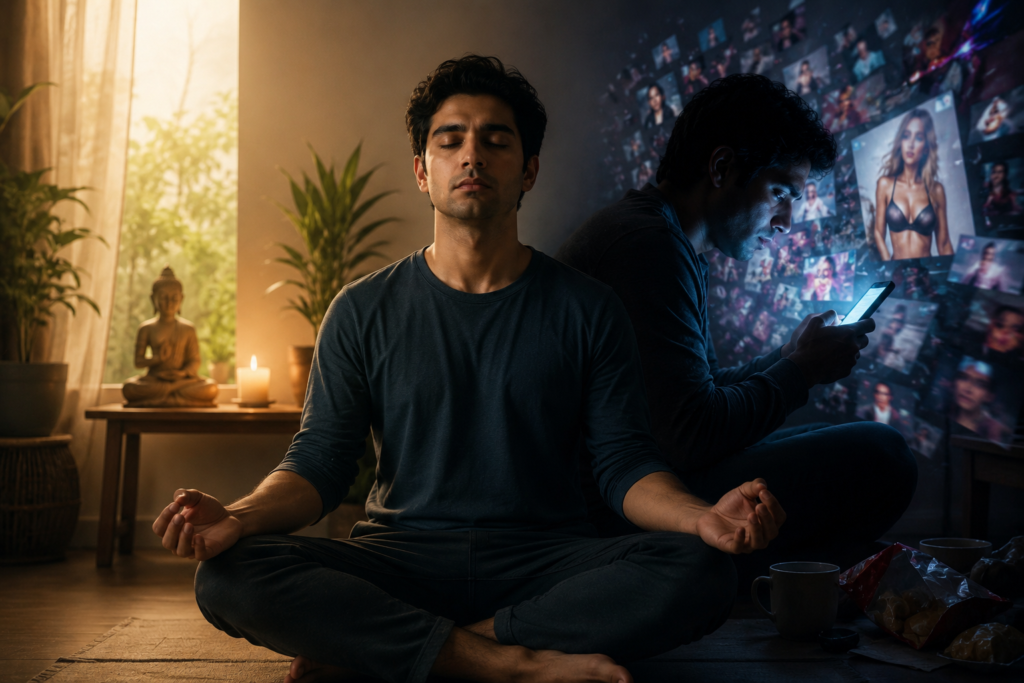
An intelligent person sitting alone at night, lost in thoughts and digital distraction
The Burden of an Overactive Mind
An intelligent mind rarely stays still.
- It analyzes.
- Predicts.
- Questions.
- Replays conversations.
- Imagines possibilities.
- Creates hypothetical futures.
- And often turns simple situations into endless psychological loops.
While this ability can create innovation and creativity, it also becomes mentally draining.
The brain remains constantly stimulated, unable to rest naturally.
This is why many highly intelligent individuals quietly struggle with:
- insomnia
- anxiety
- emotional isolation
- overstimulation
- attention fragmentation
- compulsive distraction habits
According to research discussed by Harvard Health Publishing, chronic mental overstimulation and continuous digital engagement can significantly affect emotional regulation and attention control.
And eventually, the mind begins searching for relief.
- Not truth.
- Not growth.
- Not awareness.
Relief.
Why Escapism Feels So Comforting
Escapism is not always dramatic.
Sometimes it appears harmless:
- binge watching
- social media scrolling
- obsessive gaming
- compulsive pornography consumption
- fantasy-based thinking
- emotional withdrawal
- endless online stimulation
These behaviors temporarily silence inner tension.
For a short while, the mind stops confronting:
- fear
- loneliness
- uncertainty
- inner emptiness
- unresolved desires
And this temporary relief becomes psychologically addictive.
The modern digital world is designed precisely for this.
- Every scroll.
- Every notification.
- Every explicit image.
- Every dopamine trigger.
All of it pulls attention outward, away from uncomfortable self-awareness.
This is one reason why people who intellectually understand mindfulness or meditation still struggle to practice it consistently.
Because silence forces confrontation.
Stimulation offers escape.
Why Intelligent People Often Hide Their Escapism
One of the strangest aspects of escapism is that intelligent people are often deeply aware of their own unhealthy patterns.
They know:
- they are wasting time
- overstimulating themselves
- avoiding important inner work
Yet they continue.
Why?
Because awareness alone does not dissolve psychological conditioning.
In fact, intelligence sometimes strengthens escapism.
Highly analytical people become experts at rationalizing their own behavior:
“I deserve a break.”
“This relaxes me.”
“I’ll stop tomorrow.”
“Everyone does this.”
“This is not harming anyone.”
The mind creates sophisticated justifications to protect its habits.
And because intelligent individuals often function well externally, their internal struggles remain invisible to others.
A successful professional secretly struggling with digital addiction and loneliness at night
The Strange Relationship Between Loneliness and Escapism
Many people are not escaping life.
They are escaping emotional discomfort.
Modern life has created a paradox:
people are more digitally connected than ever,
Yet emotionally disconnected internally.
Even surrounded by people, many silently experience:
- emptiness
- emotional numbness
- lack of meaning
- disconnection from themselves
This hidden loneliness fuels escapist behavior.
Research from the American Psychological Association has repeatedly explored how excessive digital dependency can increase feelings of isolation, attention fatigue, and emotional dissatisfaction.
The mind seeks stimulation because stimulation briefly masks emotional emptiness.
But the relief never lasts.
And so the cycle repeats.
Why Escapism Becomes Stronger at Night
Many people notice something peculiar.
Desires intensify at night.
Scrolling becomes endless.
Self-control weakens.
Hidden cravings emerge more strongly.
Why?
Because nighttime removes external distractions.
During the day:
work,
responsibilities,
conversations,
social structure
keep the mind occupied.
But at night, unresolved thoughts quietly return.
And the brain instinctively seeks quick dopamine-based relief.
This is why late-night behavior often reveals psychological patterns people suppress during the day.
The issue is not weakness alone.
It is accumulated mental exhaustion.
Why Silence Feels Harder Than Stimulation
One of the biggest modern contradictions is this:
People claim they want peace.
Yet they constantly avoid silence.
A person may sit for four hours consuming stimulation,
but struggle to sit silently for ten minutes.
Why?
Because silence exposes the true condition of the mind.
Without distraction, people suddenly become aware of:
- anxiety
- loneliness
- restlessness
- hidden desires
- emotional confusion
This is also why meditation initially feels uncomfortable for many beginners.
Meditation does not instantly create peace.
First, it reveals inner noise.
To understand this deeper psychological resistance and how subtle mental patterns interfere with stillness, meditation, and hidden desires, read the in-depth study published on Eastside Writers Blog.
Ancient Spiritual Traditions Understood This Long Ago
Long before smartphones and social media existed, ancient spiritual traditions repeatedly warned against overstimulation and uncontrolled desire.
Not because pleasure itself was evil.
But because compulsive stimulation weakens awareness.
Practices like:
- meditation
- yoga
- mindfulness
- breath awareness
- self-observation
were designed to help individuals regain mastery over attention.
The real battle was never against the external world.
It was against unconscious mental conditioning.
In many traditions, the inability to remain inwardly still was considered one of the greatest obstacles to higher awareness.
The Hidden Cost of Constant Escapism
Escapism temporarily feels comforting.
But over time, it quietly weakens:
- focus
- emotional stability
- discipline
- attention span
- self-respect
- inner clarity
The problem is not occasional entertainment.
The problem begins when stimulation becomes the primary method of avoiding reality.
Because eventually, the mind loses the ability to remain present without external input.
And this creates a dangerous dependency:
the inability to sit peacefully with oneself.

So, How Does Real Change Begin?
Not through guilt.
Not through self-hatred.
And not through extreme suppression.
Real change begins through awareness.
The moment a person honestly recognizes:
“I am constantly escaping myself,”
something important shifts.
Because awareness interrupts unconscious behavior.
This is where mindfulness and meditation become powerful—not as spiritual performances, but as tools for observing the mind without constantly feeding its cravings.
Slowly, the nervous system begins recovering from continuous overstimulation.
Attention stabilizes.
Silence becomes less threatening.
And the mind gradually regains clarity.
Why Hidden Desires Become Stronger in Silence
The moment silence begins, hidden desires slowly rise to the surface.
Sexual curiosity.
Fantasy.
Loneliness.
Restlessness.
The urge to escape inward discomfort.
This is one reason many people struggle to sit quietly for even a few minutes, yet can spend hours consuming stimulation on their phones without exhaustion.
The mind often chooses distraction not because it enjoys peace less, but because silence forces confrontation with thoughts and desires that were always hiding underneath constant activity.
Why the Modern Mind Prefers Stimulation Over Stillness
Modern digital platforms understand human psychology extremely well.
Endless scrolling.
Provocative content.
Dopamine-driven feeds.
Quick stimulation.
All of it is designed to keep attention externally occupied.
A person may genuinely want inner peace, meditation, or emotional clarity, yet unconsciously move toward stimulation because immediate pleasure feels easier than self-awareness.
And over time, this creates a strange contradiction:
people admire peace intellectually,
but remain deeply addicted to distraction privately.
Most people assume intelligence automatically leads to discipline, emotional balance, and self-control.
But reality quietly reveals something very different.
Final Thought
Intelligence does not protect people from escapism.
Sometimes it intensifies it.
Because the more active and overstimulated the mind becomes, the stronger the desire to temporarily escape inner pressure.
That is why so many intelligent people secretly struggle with distraction, compulsive stimulation, hidden desires, and emotional exhaustion.
The real issue is not a lack of intelligence.
It is a lack of inner stillness.
Perhaps the greatest addiction of modern life is not pleasure itself, but the inability to sit alone with our own mind.
And all the more, the greatest challenge of modern life is this:
Learning how to remain peacefully present in a world designed to constantly distract you.
#EscapismPsychology, #DigitalAddiction, #Mindfulness, #HiddenDesires, #MentalHealthAwareness, #DopamineAddiction, #MeditationAndMind, #HumanPsychology, #AttentionSpan, #InnerPeace



Pingback: Why Meditation Fails for Most People: The Hidden Struggle No One Talks About - Eastside Writers
Pingback: Why Your Mind Resists Growth: From Meditation to Desire, the Hidden Pattern Controlling Your Life - Eastside Writers
Pingback: Why You Can’t Sit in Silence—But Can Scroll for Hours to Satisfy Hidden Desires - Eastside Writers