Before We Begin—Pause for a Moment
What if everything you believe about love… is only partially true?
Not wrong. Not foolish. Not misguided.
Just… incomplete.
From the time we are children, we are gently taught how to see the world. What is normal? What is acceptable? What fits. What doesn’t? These ideas don’t come to us as instructions—they come as habits. As silent agreements we never consciously sign, yet spend our entire lives obeying.
We learn to recognize patterns before we learn to question them.
A man should be this way.
A woman should feel that way.
Love should look a certain way.
And slowly, without realizing it, we stop seeing reality as it is—and begin seeing it as we have been told to see it.
But here is a question most of us never pause to ask:
If we were never taught these definitions… would we still arrive at the same conclusions about love, identity, and what is “natural”?
Or would we see something entirely different?
Because somewhere between truth and tradition… lies interpretation.
And somewhere between what is… and what we accept as normal… lies conditioning.
This is not a blog that will try to convince you of anything.
It is a mirror.
And what you see in it may not change your answers immediately—
…but it might change the way you ask your questions.
That silence was not just between two people.
It was the kind of silence that appears when a question does not find an immediate answer—but refuses to go away.
Because, if you think about it carefully, the discomfort we feel in such situations is rarely about the situation itself.
It is about the meaning we attach to it.
My friend was not reacting to two individuals.
He was reacting to an idea—an idea that did not fit into the framework he had always believed to be “natural.”
And that is where things become interesting.
Because what we call “natural” is often not something we discover—it is something we inherit.
We inherit definitions.
We inherit boundaries.
We inherit conclusions… long before we ever examine them.
So when we encounter something that does not fit those inherited patterns, we don’t immediately try to understand it.
We try to judge it.
Not because we are intolerant.
But because we are conditioned.
And this is where a deeper question quietly emerges—one that goes beyond social labels, beyond opinions, beyond immediate reactions:
On what basis do we decide what is natural and what is not?
Is it purely biological?
Is it social acceptance?
Or is there a deeper philosophical truth that we have overlooked?
Because if we are willing to step back—just a little—we may realize something surprising:
That this is not merely a question about relationships.
It is a question about how we understand human existence itself.
And once the question reaches that depth… we cannot answer it only through society.
We have to turn to something deeper.
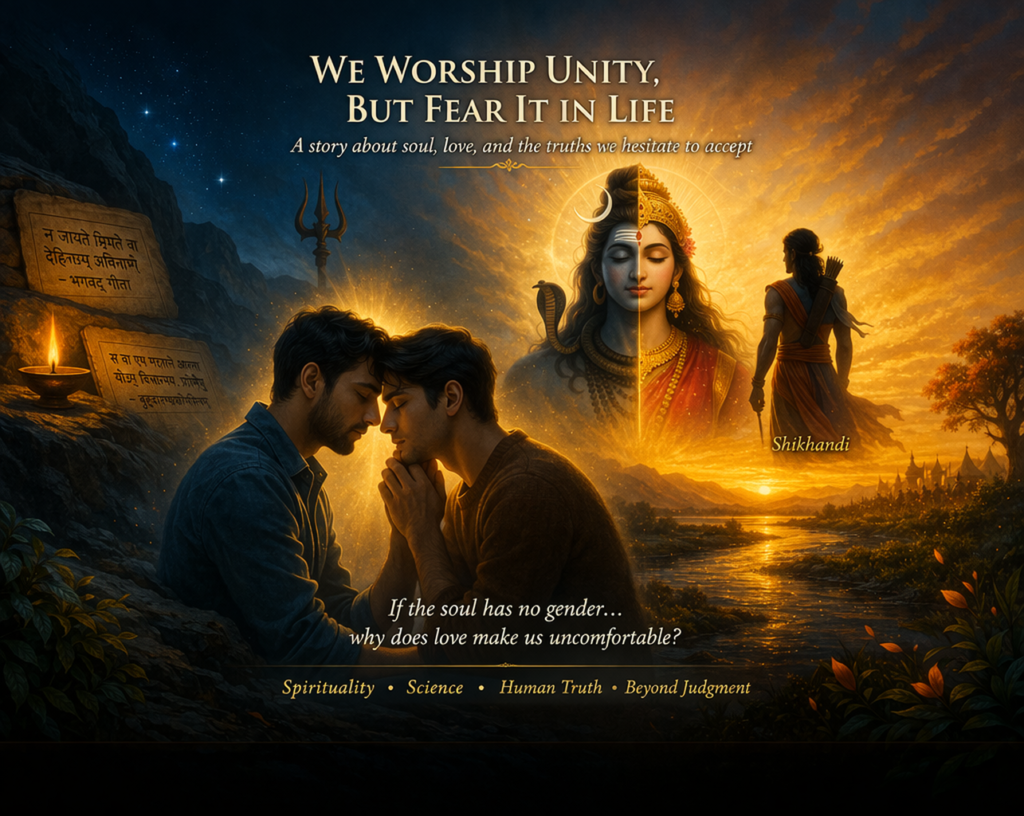
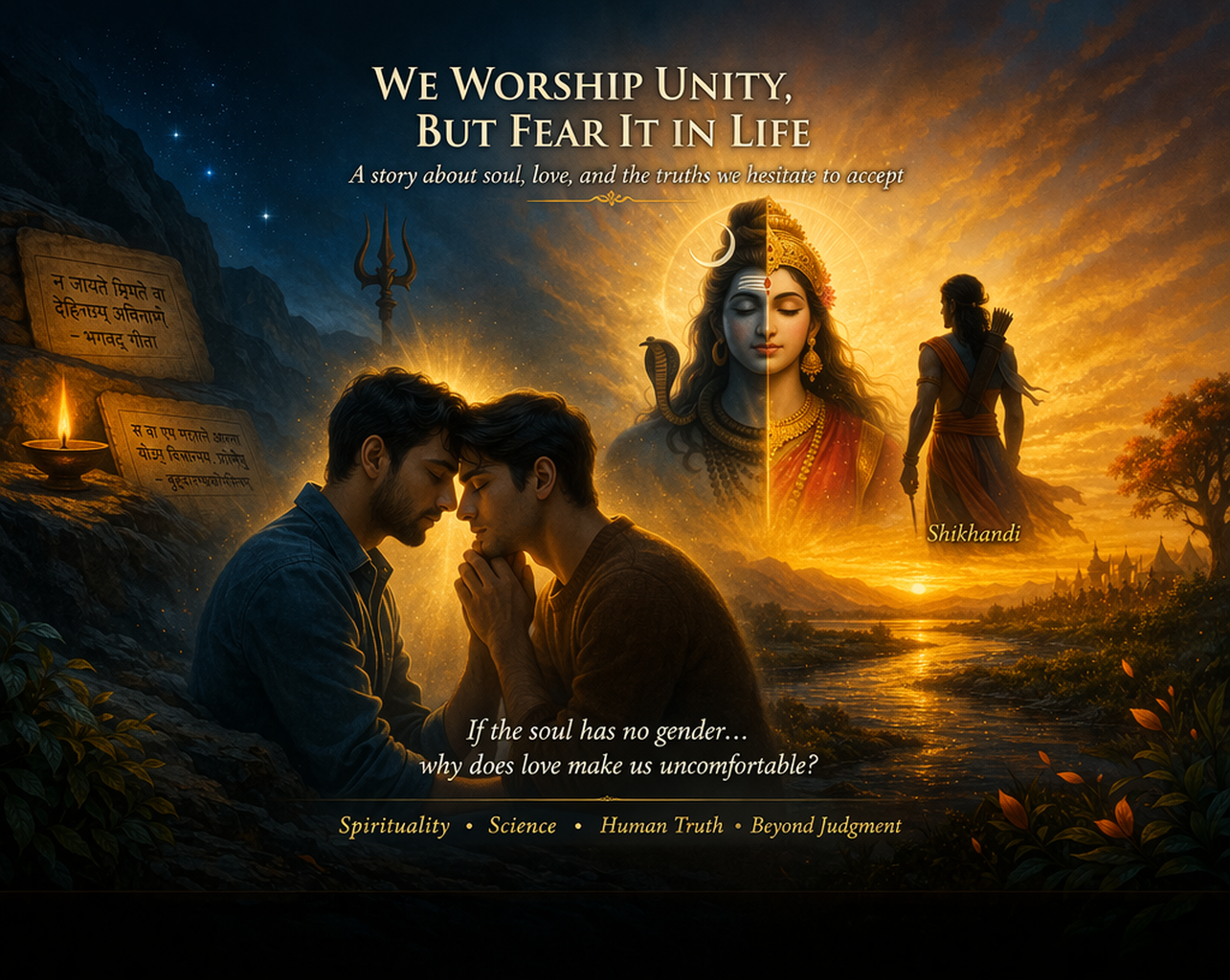
A story about soul, love, and the truths we hesitate to accept.
It Began With a Simple Conversation
A few months ago, I was sitting with a friend over tea. Nothing extraordinary—just one of those slow evenings where conversations drift from politics to philosophy without warning.
At some point, the topic turned to relationships.
He said something very casually, almost as if it were obvious:
“I don’t understand this… how can a man love another man? It’s just not natural.”
There was no anger in his voice. No hatred. Just certainty.
And that is what made it powerful.
Because most of our strongest beliefs are not loud—they are quiet, settled, unquestioned.
I didn’t respond immediately. Instead, I asked him something simple:
“Do you believe the soul has a gender?”
He paused. Smiled.
“Of course not.”
That was the beginning of a much deeper silence.
What Our Scriptures Actually Say—If We Dare to Listen
We often quote scriptures. Rarely do we sit with them.
In the Bhagavad Gita, Krishna tells Arjuna:
“The soul is neither born, nor does it die… it is eternal, unchanging.”
If the soul is beyond birth… it is beyond body.
If it is beyond body… it is beyond gender.
Then what exactly are we defending so fiercely?
The Brihadaranyaka Upanishad speaks of creation emerging from a unified being that later appears as dual—male and female—not as enemies, but as expressions of one reality.
And then comes one of the most powerful symbols in all of Indian thought:
Ardhanarishvara

The Image We Worship—but Do Not Understand
Half Shiva.
Half Parvati.
Not divided. Not competing.
But merged.
This is not mythology meant for decoration.
It is telling us that existence itself is not rigidly separated into masculine and feminine. It is fluid, interwoven, inseparable.
And yet, when this same blending reflects in human identity, in emotion, in attraction—we hesitate.
We revere it in stone.
But resist it in life.
A Tale from the Mahabharata You Already Know
Let’s look into the Shikhandi episode.
Born as Shikhandini, later living as Shikhandi, this character plays a crucial role in the fall of Bhishma.
Bhishma, bound by his own vows, refuses to fight someone he perceives as female.
And yet, it is precisely this complex identity that becomes the turning point of the war.
The epic does not erase Shikhandi.
It does not deny the complexity.
It includes it—as part of reality.
Not as a mistake.
But as a force.
Can Honestly We Reflect On This?
There is also the story of Ila, found in various Puranic texts.
Ila lives life as both male and female at different times—experiencing existence from both sides.
This is not a random tale.
It is a profound exploration of identity—not as fixed, but as experienced.
What does it mean?
Perhaps this:
The human experience is not as rigid as we assume.
Something Needs to be Admired – Not Scripture, but Reality
Let me bring you back to the present.
A man grows up being told to be strong. Not to cry. Not to express too much.
He succeeds. Builds a life. Becomes what society respects.
But something within him remains untouched—his emotional depth.
Then he meets someone—another man—who lives that emotional openness freely.
Conversations flow. Walls fall.
For the first time, he feels understood.
Now pause.
Before labeling it, ask:
Or is it recognition?
Is he drawn to the person…
Or to the part of himself he was never allowed to express?
What Science Quietly Confirms
Science, in its own language, echoes something similar.
- Every human carries both testosterone and estrogen
- The brain is not strictly “male” or “female.”
- Psychological traits exist on a spectrum
There is no perfect binary.
Only variation.
Only degrees.
Only complexity.
And when human nature is complex, human behavior cannot always be predictable.
The Animal Argument—A Half Truth
People often say:
“Animals don’t do this.”
But even if we pause that debate, there is something deeper:
Animals live through instinct.
Humans live through awareness.
We don’t just feel.
We interpret.
We question.
We struggle with meaning.
And that changes everything.
Where Society Feels Threatened
Society is built on structure.
Family. Lineage. Roles.
Anything that does not fit neatly into this structure feels like a disruption.
Not necessarily wrong—but unsettling.
But history shows us something clearly:
Every structure that survives… evolves.
There was a time when many accepted ideas today were once rejected.
And yet, society adapted.
The Part We Rarely Admit
Attraction is not always about the other person.
Sometimes, it is about ourselves.
We are drawn to:
- What we understand
- What we have suppressed
- What we long to express
A woman drawn to the strength she was never allowed to show.
A man drawn to sensitivity, he was taught to hide.
This is not the only explanation.
But it is an important one.
Because it tells us:
Human connection is not just biological.
It is deeply psychological.
So What Is Right? What Is Wrong?
Perhaps the more honest answer is:
We are still understanding.
Spirituality points toward unity.
Science points toward complexity.
Society seeks structure.
And human beings stand at the intersection of all three.
The Question That Remains
Instead of asking:
“Why do some people love differently?”
Ask:
“Why does it disturb me?”
What belief is being challenged?
What certainty is being shaken?
Because discomfort is often a mirror.
A Quiet Ending
That day, my friend did not argue.
He did not agree either.
But something changed.
The certainty in his voice softened.
And in its place came something far more powerful:
A question.
Final Thought

We read the Bhagavad Gita.
We admire Ardhanarishvara.
We speak of unity.
Perhaps the real challenge is not to believe these ideas…
…but to live them.
And maybe, just maybe…
The question is not whether love needs to change.
The question is whether our understanding is ready to grow.
Spirituality, #HumanConsciousness, #BeyondGender, #LoveAndIdentity, #PhilosophyOfLife, #DeepThinking, #MindfulLiving, #InnerJourney, #SelfReflection, #TruthSeeking, #SocialAwareness, #HumanNature, #PsychologyOfLove, #BreakingNorms, #ThoughtProvoking, #SpiritualWisdom, #ModernPhilosophy, #ConsciousLiving, #EvolvingSociety, #QuestionEverything
Disclaimer:
All views and opinions expressed in this article are solely those of the author and are published in good faith. EastSideWriters does not guarantee the accuracy, completeness, or reliability of the information presented and shall not be held responsible for any outcomes, interpretations, or actions taken based on this content.
Note: Contact our Writers at www.eastsidewriters.com for writing Blogs/Articles on any niche. We have experts in various domains, ranging from Technology to Finance, and from Spirituality to Lifestyle and Entertainment.