
Between What We Experience and What We Can Prove
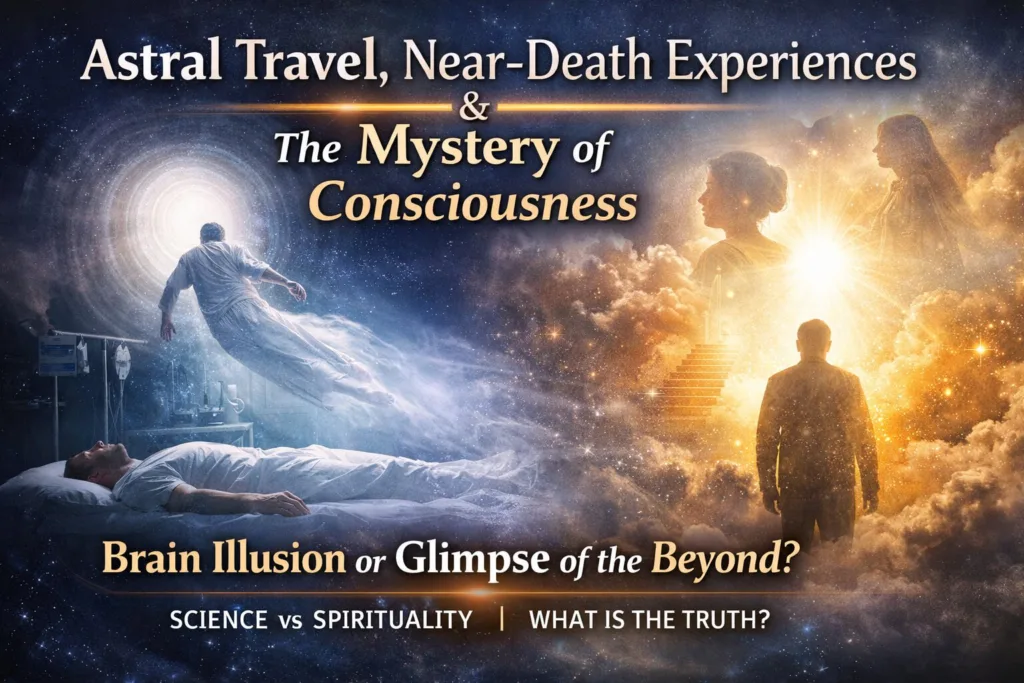
Certain ideas refuse to leave the human mind. No matter how advanced science becomes, no matter how much logic we apply, these questions continue to linger in the quiet corners of our thoughts. What happens when we die? Can we exist beyond the body? Can consciousness travel? Or are all such experiences nothing more than elaborate illusions created by the brain?
In today’s digital age—especially on platforms like YouTube—these questions have taken on a new life. Thousands of people narrate deeply personal stories of leaving their bodies, floating above hospital beds, meeting deceased relatives, or even traveling across space. These accounts are often compelling, emotional, and described with such conviction that one is almost persuaded to believe them.
And yet, beneath that persuasion, a quiet doubt remains.
The Experience That Feels More Real Than Reality
Imagine lying still, your body unmoving, yet you suddenly feel a shift. Your perspective changes. You are no longer inside your body—you are above it. You can see yourself. You can move without limbs. You are aware, alert, and strangely calm.
For those who report such experiences, this is not imagination. It does not feel like a dream. It feels sharper, clearer, more “real” than ordinary waking life.
This is where the discussion must begin—not by dismissing these experiences, but by acknowledging their intensity. The question is not whether people experience these states. They do. The real question is: what is the source of that experience?
The Brain: Architect of Reality
Modern neuroscience offers a perspective that is both fascinating and unsettling. It suggests that what we call “reality” is not directly perceived but actively constructed by the brain. Every moment, your brain integrates signals from your eyes, ears, skin, and inner ear to create a seamless sense of “being here.”
At the center of this construction lies a region known as the Temporoparietal Junction. This area plays a crucial role in determining where “you” are located in space. It merges sensory inputs to create a stable sense of self-position.
But what happens if this system is disturbed?
Under certain conditions—extreme stress, sleep paralysis, deep meditation, or neurological disruption—the brain’s integration can falter. When that happens, something extraordinary occurs: the brain may relocate your sense of self. You may still see your body, but you no longer feel that you are inside it.
The result is what science calls an out-of-body experience.
This is not a simple act of imagination. It is a full-scale simulation. The same neural circuits that process real sensory information are activated, creating an experience that is immersive and convincing. In such a state, there is no internal signal telling you, “This is not real.” As far as your brain is concerned, it is reality.
Between Leaving and Being Moved
What people describe as “leaving the body” may not involve movement at all. It may instead be a relocation of awareness within the brain’s internal map.
Think of it like a camera in a film. The character does not move, but the camera angle changes. Suddenly, the perspective shifts from inside the body to somewhere above it. The experience feels like travel, but what has actually changed is the point of view.
This distinction is subtle, yet crucial.
Near-Death Experiences: At the Edge of Life
If astral travel raises questions, near-death experiences deepen them further. These are often reported by individuals who have come close to death—particularly during cardiac arrest.
They speak of tunnels, light, peace, and encounters with beings or loved ones. Some claim to have observed their own lifeless body, surrounded by grieving relatives or medical staff.
At first glance, such accounts seem to defy explanation. But here again, science asks us to look carefully at the boundary between life and death.
Most individuals who report these experiences were not biologically dead. Their hearts may have stopped, but their brains had not yet undergone irreversible shutdown. In that narrow window, the brain is under extreme stress. Oxygen levels drop, neural activity becomes chaotic, and powerful neurochemicals flood the system.
This altered state can produce vivid imagery, emotional intensity, and a profound sense of detachment. Tunnel vision, for instance, can arise from reduced oxygen supply to the visual cortex. The sensation of peace may result from endorphins released under extreme stress.
What emerges is not randomness, but a structured experience—a narrative constructed by the brain in its most vulnerable state.
The Familiar Faces We Meet
One of the most emotionally powerful aspects of these experiences is the appearance of loved ones who have passed away. People often describe conversations, guidance, or a sense of reunion.
From a scientific standpoint, this can be understood through the activation of deep memory and emotional circuits, particularly within the Limbic System. This system holds not just memories, but the emotional essence of relationships.
When activated intensely, it can recreate a person so vividly that the experience transcends memory. It becomes presence.
What you feel is not “I remember them,” but “they are here.”
A Mirror of Culture and Belief
An intriguing pattern appears when we look at these experiences across cultures. The figures encountered often reflect the individual’s background. In some traditions, people see divine beings or messengers of death. In others, they encounter figures central to their faith.
This variation raises an important possibility: the brain may be drawing upon familiar symbols to construct meaning in a moment of crisis. Rather than revealing a single, universal afterlife, these experiences may reflect deeply ingrained cultural narratives.
Testing the Unseen
To move beyond speculation, researchers have attempted to test whether consciousness truly leaves the body. In controlled settings, hidden objects have been placed in locations visible only from an elevated perspective. If individuals were genuinely floating above their bodies, they should be able to identify these objects.
So far, results have not supported this claim.
Studies, including those led by Sam Parnia, have explored awareness during near-death states. While some patients report vivid experiences and even accurate perceptions of timing, there is no consistent evidence that they can perceive hidden visual information from outside their bodies.
This does not invalidate the experience—but it challenges the interpretation.
The Spiritual Counterpoint: Beyond the Brain
While science focuses on mechanisms, spiritual traditions ask a different question: what if consciousness is not produced by the brain at all?
Advaita Vedanta, one of the most profound philosophical systems from India, offers a radically different view. It suggests that the body and mind are not the true self. They are instruments—temporary, changing, and limited.
The true self, or Atman, is pure consciousness—unchanging, ever-present, and not confined to physical space.
From this perspective, the idea of “leaving the body” becomes almost irrelevant. Consciousness does not need to travel, because it is not located in space to begin with. What we experience as movement may simply be shifts within the mind.
This view does not confirm astral travel in the literal sense, but it does open the door to a deeper inquiry: if we are not the body, then what are we?
The Age of Amplification
In today’s world, personal experiences no longer remain personal. They are recorded, edited, and shared with millions. Platforms reward attention, and attention often gravitates toward the extraordinary.
This creates a complex environment where:
- Genuine experiences are shared
- Interpretations become exaggerated
- Narratives evolve for engagement
It becomes increasingly difficult to separate honest accounts from embellished storytelling. Some individuals may sincerely believe what they describe. Others may consciously or unconsciously amplify their experiences to gain recognition or influence.
This does not mean everything is false—but it does mean everything must be examined carefully.
Why We Want It to Be True
At the heart of all this lies a deeply human desire. The idea that we are more than our bodies, that death is not the end, that we can reconnect with those we have lost—these are not just beliefs. They are emotional needs.
Such ideas offer comfort, meaning, and hope. They soften the harsh finality of death and expand the boundaries of existence.
But desire does not equal truth.
Where Does That Leave Us?
We stand between two powerful perspectives.
On one side, science shows us that the brain is capable of creating astonishingly vivid realities—complete with movement, identity, and narrative. It explains how we can feel outside our bodies without ever physically leaving them.
On the other side, spirituality reminds us that consciousness itself remains a mystery. Despite all our knowledge, we still cannot fully explain what awareness is, or why it exists at all.
Questions surrounding Astral Travel often lead seekers toward broader explorations of Tantra, Kundalini, karma, and the nature of consciousness itself, themes examined in Beyond Religion: The Ancient Inner Sciences Of Tantra, Kundalini, Karma, And Akashic Records Explained.
Perhaps the most honest position is not certainty, but openness.
A Quiet Reflection
You may never experience an out-of-body journey. You may never see a tunnel of light or encounter a presence beyond explanation.
And yet, the deeper question remains untouched:
If the brain can create such convincing realities, then what is reality itself?
And if consciousness can observe even these illusions, then who—or what—is the observer?
In the end, the mystery is not whether we can leave the body.
The mystery is understanding the one who believes they are inside it.
#Consciousness #Spirituality #Neuroscience #LifeAfterDeath #HumanMind #Philosophy #SelfAwareness #MindAndBody
Disclaimer:
All views and opinions expressed in this article are solely those of the author and are published in good faith. EastSideWriters does not guarantee the accuracy, completeness, or reliability of the information presented and shall not be held responsible for any outcomes, interpretations, or actions taken based on this content.
Note: Contact our Writers at www.eastsidewriters.com for writing Blogs/Articles on any niche. We have experts in various domains, ranging from Technology to Finance, and from Spirituality to Lifestyle and Entertainment.


Pingback: Beyond Religion: The Ancient Inner Sciences Of Tantra, Kundalini, Karma, And Akashic Records Explained - Eastside Writers
Pingback: What Happens After Death? Exploring Consciousness, Reincarnation, and Life Beyond Death - Eastside Writers
Pingback: Can Meditation Reveal Your Past, Future, and Hidden Potential? - Eastside Writers
Pingback: Near-Death Experiences: Evidence or Illusion? The Chilling New Science That Changes Everything – Eastside Writers