
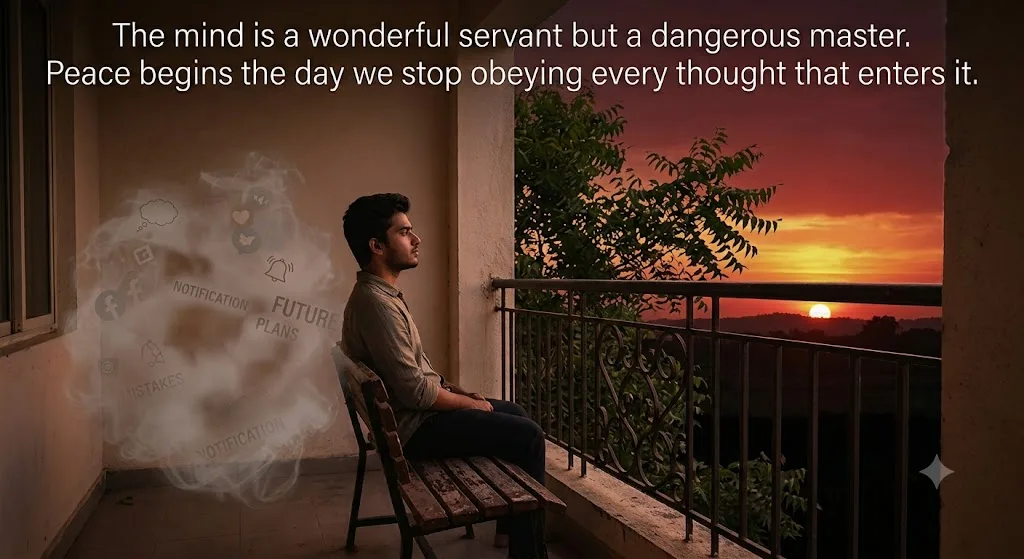
“The mind is a wonderful servant but a dangerous master. Peace begins the day we stop obeying every thought that enters it.”
A few evenings ago, my nephew dropped by unexpectedly. He had just returned from college, but instead of his usual cheerful self, he looked unusually quiet. We sat on the balcony as the evening breeze gently moved the leaves of the neem tree outside. For several minutes, neither of us spoke. Sometimes silence reveals more than conversation ever can.
As the sky slowly turned crimson, he finally looked at me and asked, “Uncle, does your mind ever stop talking?” It wasn’t the kind of question that demanded an immediate answer. It was the kind of question that carried exhaustion, confusion, and a silent plea for relief.
I smiled because I had once asked exactly the same question. Years ago, I too had believed that there must be a secret switch somewhere inside the mind—a way to silence the endless stream of thoughts that followed me from morning till night. Like millions of people, I believed the problem was that I thought too much.
“My mind keeps replaying old conversations,” he continued. “When I sit down to study, I start worrying about my future. At night, I remember mistakes I made years ago. Sometimes I even imagine problems that haven’t happened yet. Why can’t I just switch it off?”
His words lingered in my heart long after he left.
Perhaps you have never asked your uncle that question. Perhaps you typed it into Google instead. “Why can’t I stop thinking?” “How do I quiet my mind?” “Why is my brain always busy?” Different words, but the same silent struggle.
Before we go any further, let me tell you something I wish someone had told me years ago.
There is nothing wrong with you.
Your restless mind does not mean you are weak. It does not mean meditation is beyond your reach. It certainly does not mean you are broken. It simply means you have been trying to solve the wrong problem.
The problem is not that your mind thinks.
The real problem is that no one ever taught us how to live with our thoughts without becoming their prisoner.
The Noisiest Generation in Human History
Human beings have always faced challenges. Our ancestors worried about finding food, protecting their families, and surviving another day. Their worries were real, immediate and often life-threatening.
Our generation faces a different kind of danger. Before we even finish breakfast, our minds have consumed dozens of notifications, headlines, emails, social media posts, advertisements and opinions from complete strangers. We are constantly connected to the world, yet strangely disconnected from ourselves.
Our minds rarely receive a moment of uninterrupted rest. Even when the body is sitting quietly, the brain continues scrolling through memories, expectations and imagined futures. We have become experts at filling every empty moment, but beginners at simply being present.
Perhaps that is why silence has become uncomfortable.
Many people fear being alone not because they dislike solitude, but because the moment external noise disappears, they come face to face with the noise they have been carrying within themselves for years.
Advice That Sounds Good but Never Works
Whenever someone admits they cannot stop overthinking, they usually receive well-meaning advice.
“Relax.”
“Forget about it.”
“Don’t worry so much.”
“Think positively.”
If you have ever struggled with an anxious mind, you already know how useless that advice feels.
Imagine I tell you not to think about a pink elephant for the next thirty seconds. The very effort of avoiding the thought forces your mind to create it. The harder you resist it, the stronger it becomes.
Modern psychologists call this ironic processing. Ancient sages understood the same truth thousands of years ago without scientific terminology. They realised that force can suppress thoughts temporarily, but only understanding can transform our relationship with them.
Trying to stop thinking is like trying to smooth water with your hands. Every attempt creates another ripple.
The Monkey Mind According to Swami Vivekananda
More than a hundred years ago, Swami Vivekananda gave one of the most vivid and unforgettable descriptions of the human mind. Rather than explaining it through complicated philosophy, he painted a picture that is impossible to forget. He asked his listeners to imagine a monkey—restless by its very nature, constantly jumping from one branch to another without ever remaining still.
“But that,” Vivekananda said, “is only the beginning.” Imagine someone giving that monkey plenty of wine to drink until it becomes completely intoxicated. As if its condition were not miserable enough, a scorpion suddenly stings it, making it leap about in unbearable pain. Finally, to complete its misery, a demon enters the monkey. Then he asks a remarkable question: “What language can describe the uncontrollable restlessness of that monkey?”
Only after capturing everyone’s imagination did Vivekananda reveal the deeper meaning hidden within the story. The monkey represents the ordinary human mind, restless by its very nature. The wine symbolises desire, which makes the mind even more agitated and difficult to control. Then comes the sting of the scorpion—jealousy, which arises the moment we compare ourselves with the success, happiness or achievements of others. Finally, the demon represents pride or ego, convincing us that our opinions, ambitions and worries are more important than everything else.
It is astonishing how accurately this century-old analogy describes the modern world. Our minds leap endlessly from one thought to another. We desire what we do not have, compare ourselves with people we barely know, feel disturbed by another person’s success, and allow our ego to magnify even the smallest events into major emotional battles. Although technology has transformed our lives, the basic nature of the human mind has changed very little.
Perhaps that is why Vivekananda’s words continue to resonate even today. He was not describing a rare psychological condition. He was describing the everyday experience of almost every human being. Once we recognise this restless “monkey mind,” we stop blaming ourselves for having thoughts and begin learning the real purpose of meditation—not to destroy the mind, but to understand it, gently train it, and eventually discover the quiet awareness that has always existed beyond its constant chatter.

The Question That Changes Everything
For many years, I believed meditation was about forcing the mind to become completely silent. Every session became a quiet battle between me and my thoughts. The moment a thought appeared, I assumed I had failed, and after enough failed attempts, I quietly concluded that perhaps meditation was meant for people with calmer minds than mine.
Then one day I came across a simple experiment suggested by Eckhart Tolle in The Power of Now. It was so ordinary that I almost dismissed it. Yet, in those few moments, it revealed something that years of struggling with meditation had failed to teach me.
He invites the reader to close their eyes and ask a simple question: “I wonder what my next thought is going to be.” Then he says, become completely alert and wait for that thought, like a cat patiently watching the entrance to a mouse hole, waiting for the mouse to appear.
Curious, I tried it.
For a brief moment, something unexpected happened. There was no thought. My mind, which usually rushed from one idea to another without permission, became completely still. It wasn’t because I had forced it into silence. It was because, for the first time, I wasn’t chasing my thoughts. I was quietly waiting for them to appear.
Those few seconds changed the way I understood meditation.
I realised that if I could wait for my next thought, then I could not possibly be that thought. There had to be another presence within me—the one patiently watching, alert yet completely undisturbed. The thought came and went, but the observer remained.
The sages of the Upanishads pointed towards this same discovery thousands of years ago. They spoke of the silent witness—the unchanging awareness that exists behind every thought, every emotion and every experience. Thoughts rise and fall like waves upon the surface of the ocean, but the depth of the ocean remains untouched by every passing wave.
Perhaps that is where our search for peace has taken a wrong turn. We spend years trying to change the waves, making them smaller, calmer or more beautiful. Yet the real invitation of meditation is not to control the waves at all. It is to discover the vast ocean beneath them—the quiet awareness that has been patiently witnessing every thought since the day we were born.
From that day onward, I stopped asking, “How do I stop my thoughts?” Instead, I began asking a far more meaningful question: “Who is aware of these thoughts?” Strangely enough, the moment that question became more important than the thoughts themselves, the mind began to lose its grip over me.
Nachiketa’s Extraordinary Question
One of my favourite stories from the Katha Upanishad is about a young boy named Nachiketa. Unlike most children, he possessed an extraordinary quality. He refused to accept half-truths.
During a sacred ritual, he noticed his father donating old and weak cows while pretending to perform an act of generosity. The ritual appeared noble from the outside, but sincerity was missing within. Young Nachiketa quietly observed this contradiction and repeatedly asked his father, “To whom will you give me?”
Irritated by the persistent questioning, his father blurted out in anger, “I give you to Yama, the Lord of Death.”
Most children would have reacted with fear.
Nachiketa did not.
Standing before Yama, he was offered wealth, pleasure, power, long life and every worldly comfort imaginable. Yet he refused them all because one question mattered more than everything else.
“What is the truth of the Self? What remains when everything else passes away?”
That story has fascinated seekers for thousands of years because it reminds us that wisdom begins with the courage to ask the right question.
Our minds rarely stay with one meaningful question. They abandon one worry only to chase another. They move from fear to regret, from comparison to desire, never pausing long enough to discover the quiet space beneath them.
Perhaps the first step towards inner peace is not finding more answers. Perhaps it is learning to remain patiently with one sincere question.
Why Memory Sometimes Becomes Our Greatest Burden
Memory is one of the greatest gifts nature has given us. Without it we would not recognise our loved ones, learn from experience or grow wiser with age.
Yet memory also has another side.
It has an extraordinary ability to reopen wounds that life had already closed.
A conversation that lasted three minutes can disturb us for three years. A careless remark spoken by someone decades ago can continue shaping the way we see ourselves. Many people believe they are suffering because of what happened in the past. More often, they are suffering because the mind refuses to stop replaying it.
Life hurts us once.
Memory keeps negotiating with the pain long after life has moved on.
The Zen Master Who Solved the Mystery of the Restless Mind
There is an old Zen teaching about a young disciple who became deeply frustrated with his meditation. For months he had tried to stop his thoughts, believing that a successful meditation meant a completely silent mind. Yet the harder he tried, the noisier his mind seemed to become.
One morning he approached his master with a look of defeat.
“Master,” he said, “I have failed again. Every time I sit to meditate, my thoughts become even louder. The more I try to stop them, the more they seem to multiply. What am I doing wrong?”
The master did not answer immediately. Instead, he invited the young disciple for a walk through the forest. After some time they reached a small pond whose water had been disturbed by the wind and passing animals. The surface was cloudy, and the mud beneath had risen, making the water impossible to see through.
The master pointed towards the pond and asked, “How do you think we can make this water clear again?”
The disciple looked for a practical solution.
“We could remove the mud,” he suggested. “Or perhaps filter the water. Maybe we should stir it in another direction.”
The master gently shook his head.
Instead of doing anything, he simply sat down beside the pond. The disciple sat beside him, confused. Neither of them spoke. They waited quietly as the wind became still. Gradually, without anyone touching it, the mud began settling to the bottom. Little by little, the water became perfectly clear, reflecting the blue sky above.
The master smiled and finally broke the silence.
“Your mind is exactly like this pond. Every time you fight your thoughts, you stir the mud again. Every attempt to force the mind into silence creates another disturbance. Leave it alone for a while. Watch it with patience instead of resistance, and it will slowly find its own stillness.”
When I first came across this teaching, I realised I had been making the same mistake for years. I believed meditation was about controlling the mind. Every thought felt like proof that I had failed. Without realising it, I had turned meditation into another competition—one more thing to succeed or fail at.
The truth is far more compassionate.
Meditation is not the art of forcing the mind to become silent. It is the art of allowing the mind to settle naturally while learning to observe it without judgement. Thoughts may continue to arise, just as ripples occasionally appear on a pond, but they no longer disturb the deeper stillness beneath the surface.
Perhaps peace has never been something we had to create. Like the clear water beneath the mud, it has always been there, patiently waiting for us to stop stirring it.
Arjuna Asked the Same Question
Whenever I feel discouraged by my wandering mind, I remember a conversation from the Bhagavad Gita. Standing on the battlefield of Kurukshetra, Arjuna confessed something that millions of meditators still experience today.
He said to Lord Krishna, “The mind is restless, turbulent, powerful and stubborn. To control it seems as difficult as controlling the wind.”
Isn’t that an astonishing admission?
This was not an ordinary man complaining about an ordinary problem. Arjuna was disciplined, courageous and spiritually inclined, yet he still found his own mind difficult to master. His struggle reminds us that restlessness is not a personal failure. It is part of the human condition.
Krishna’s response was equally profound.
He did not dismiss Arjuna’s concern. He acknowledged that the mind is indeed restless. Then he offered two timeless principles that remain relevant even today—abhyasa (steady practice) and vairagya (detachment).
Practice means gently bringing the wandering mind back again and again without frustration. Detachment means refusing to become emotionally entangled with every passing thought. Together they form the foundation of meditation, not as an escape from life but as a wiser way of living it.

We Believe Every Thought We Think
One of the strangest habits of the human mind is that it treats every thought as if it were the truth.
A thought appears saying, “I am not good enough,” and we believe it. Another thought whispers, “Nothing will ever change,” and we surrender to it. A third thought predicts disaster tomorrow, and our body begins reacting as though that disaster has already arrived.
But thoughts are not facts.
They are mental events.
Just as clouds pass through the sky without changing the sky itself, thoughts pass through awareness without changing who you truly are. The difficulty begins when we mistake passing clouds for our permanent identity.
Meditation does not ask us to destroy the clouds.
It gently reminds us to rediscover the sky.
The Mirror Covered with Dust
The sages of the Upanishads often compared the human mind to a mirror. A mirror naturally reflects whatever stands before it, but if it remains neglected for years, a layer of dust slowly covers its surface. The reflection appears distorted, not because the mirror has lost its nature, but because it has lost its clarity.
Our minds collect dust in much the same way.
Every resentment we refuse to forgive, every comparison we nurture, every unnecessary fear we repeatedly entertain, and every emotional wound we refuse to understand leaves another thin layer upon the mirror. Eventually we begin believing the distorted reflection is reality itself.
Meditation is not about creating a new mind.
It is about cleaning the mirror we already possess.
As the dust slowly disappears, clarity returns naturally. Peace is not manufactured. It is revealed.
Why We Are So Mentally Exhausted
Many people say they feel tired even after sleeping for eight hours. Doctors often find nothing physically wrong, yet the exhaustion remains. The reason is that mental fatigue follows different rules from physical fatigue.
Imagine carrying a heavy backpack every waking hour. Eventually, your shoulders would ache even if you never ran a marathon. Our thoughts create a similar burden. Every unresolved worry, every imagined conversation, every regret, and every future anxiety quietly occupies mental space.
The body rests during sleep.
The mind often does not.
Perhaps true rest begins not when we sleep longer but when we think more wisely.
What Can You Do Beginning Tonight?
You do not need a Himalayan cave to experience moments of peace. Nor do you need to meditate for an hour every day. Great journeys rarely begin with dramatic changes. They begin with small acts repeated consistently.
Tomorrow morning, before touching your phone, sit quietly for five minutes. Do not try to silence your mind. Simply notice your breathing and gently observe whatever thoughts arise. Each time your attention wanders, bring it back with kindness rather than criticism. Returning is not failure; returning is the practice.
During the day, take one slow walk without music or conversation. Notice the sound of birds, the movement of leaves, and the rhythm of your own footsteps. Nature has an extraordinary ability to remind us that life has always moved more slowly than our thoughts.
Before sleeping, write down the three thoughts that disturbed you most during the day. Seeing them on paper often weakens their emotional grip. The mind has a habit of exaggerating problems that appear much smaller once they are written down.
Finally, spend a few minutes reading something that nourishes your inner life rather than your anxiety. A page from the Bhagavad Gita, the Dhammapada, the Upanishads or the teachings of Ramana Maharshi can calm the mind far more effectively than another half-hour of scrolling through endless social media feeds.

Peace Was Never Missing
Years after that evening conversation, my nephew visited again. This time he looked different. Not because life had become easier. He still had examinations, career worries, and family responsibilities like everyone else.
As we finished our evening tea, I asked him the same question he had once asked me.
“So,” I smiled, “does your mind still talk?”
He laughed.
“Oh yes,” he replied. “It talks just as much as before. The only difference is that I no longer believe everything it says.”
I realised then that he had understood something that takes many people an entire lifetime to discover.
Peace does not arrive because the mind becomes silent.
Peace arrives because we stop giving every passing thought the authority to disturb us.
Before You Leave…
If your mind still feels restless after reading these words, please don’t become discouraged. You are not behind in your spiritual journey, nor are you failing at meditation. You are simply learning a new relationship with your own mind, and like every meaningful relationship, it requires patience.
Tonight, before you close your eyes, sit quietly for just two minutes. Don’t fight your thoughts and don’t chase silence. Simply notice that there is a quiet presence within you that has been watching every thought, every emotion, and every experience since childhood.
That silent witness has never been disturbed, even when the mind was.
Perhaps that is who you really are.
And perhaps the journey towards inner peace does not begin by changing your mind.
It begins by discovering the one who has been quietly watching it all along.
“The mind will continue creating waves. Your task is not to stop the ocean. Your task is to discover that you are far greater than the waves.”
Further Reads
You may also find these articles helpful:
- Why Meditation Fails: 9 Hidden Reasons You Keep Struggling
- Why Understanding Yourself Is the Hardest Journey in Life
- Why Kutastha (Christ Consciousness) Makes You Naturally Magnetic
- Can Meditation Reveal Your Past, Future, and Hidden Potential?
- The Hidden Resistance to Meditation: What Your Mind Doesn’t Want You to Know
- Why Sexual Thoughts Arise During Meditation: The Science, Psychology, and Spiritual Perspective
- Why Your Mind Resists Growth: From Meditation to Desire, the Hidden Pattern Controlling Your Life
- How Reincarnation Works and What Your Soul Experiences Between Lives
Frequently Asked Questions (FAQs)
1. Why can’t I quiet my mind during meditation?
A restless mind is natural. Meditation doesn’t ask you to stop thinking—it teaches you to observe your thoughts without becoming trapped in them. With consistent practice, mental chatter gradually loses its grip.
2. Is overthinking a sign that meditation isn’t working?
No. Many people become more aware of their thoughts when they first begin meditating. This increased awareness is actually a sign that meditation is helping you see your mind more clearly.
3. How long does it take for meditation to calm the mind?
There is no fixed timeline. Some people notice changes within a few weeks, while others take longer. The goal isn’t instant silence but developing greater awareness and inner stability over time.
4. Can meditation stop racing thoughts completely?
Meditation doesn’t eliminate thoughts. Instead, it changes your relationship with them. Thoughts may still arise, but they no longer dominate your attention or emotions as strongly.
5. What causes constant overthinking?
Overthinking often arises from fear, uncertainty, past experiences, future worries, and the mind’s habit of seeking control. Meditation helps you recognize these patterns without being controlled by them.
6. Which type of meditation is best for overthinking?
Mindfulness meditation, breath awareness, and Kriya Yoga meditation are all effective. The best practice is the one you can follow consistently with patience and sincerity.
7. Why does my mind become noisier when I start meditating?
When external distractions reduce, you begin noticing thoughts that were always present. Meditation doesn’t create mental noise—it reveals what was already there.
8. Can meditation help with anxiety caused by overthinking?
Yes. Regular meditation can reduce anxiety by improving emotional regulation, increasing self-awareness, and helping you respond to thoughts instead of reacting automatically.
#Meditation #Overthinking #Mindfulness #InnerPeace #SelfAwareness #MentalClarity #Consciousness #SpiritualGrowth #MeditationPractice #PresentMoment #HealingJourney #Awareness #PeaceOfMind #MentalWellness #KriyaYoga #StressRelief #EmotionalHealing #RestlessMind #PersonalGrowth #EastsideWriters


Pingback: Why Meditation Fails for Most People: The Hidden Struggle No One Talks About - Eastside Writers
Pingback: The Hidden Resistance to Meditation: What Your Mind Doesn’t Want You to Know - Eastside Writers
Pingback: Why Your Mind Resists Growth: From Meditation to Desire, the Hidden Pattern Controlling Your Life - Eastside Writers
Pingback: Why You Can’t Sit in Silence—But Can Scroll for Hours to Satisfy Hidden Desires - Eastside Writers
Pingback: Tips To Help You To Concentrate While In Meditation
Pingback: The Life We Keep Waiting For: What Manifestation Really Means - Eastside Writers