
The operating room is a sterile, freezing, chaotic mess. A 46-year-old cardiac patient has just flatlined.
To the medical team rushing to charge the defibrillator paddles, the patient is clinically dead. The heart has stopped pumping blood. Within fifteen to twenty seconds, the electrical activity in the cerebral cortex vanishes. The brain waves flatten into a completely straight line. By every standard definition of modern biological science, nobody is home. The machine is broken, and the consciousness inside it should be completely dark.
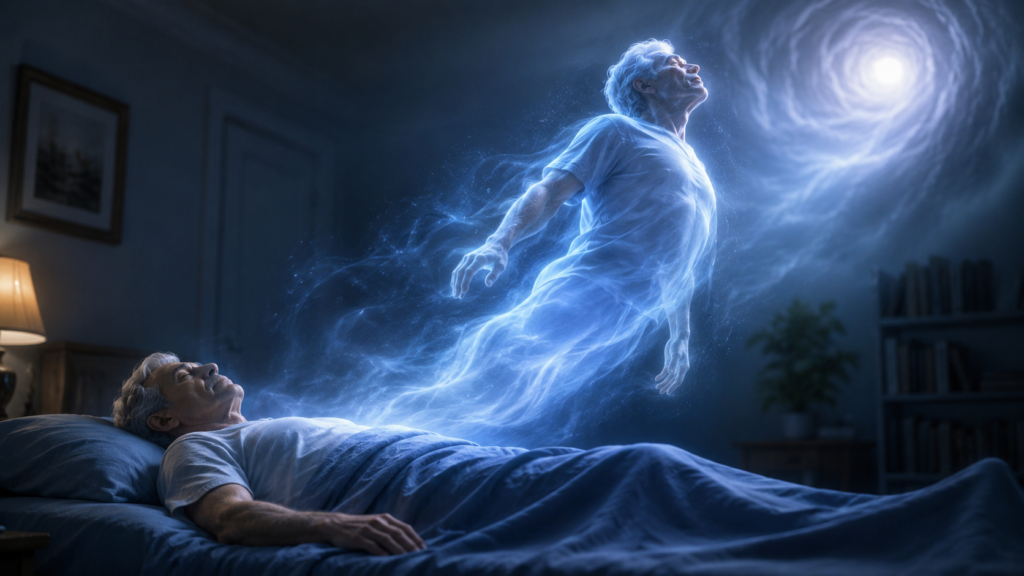
Yet, twenty minutes later, after a grueling resuscitation effort, the patient’s heart kicks back into rhythm. When they finally open their eyes in the intensive care unit, they do not talk about blackness, coldness, or a state of non-being. Instead, they calmly describe floating effortlessly above the operating table.

They describe the frantic movements of the doctors, the exact words spoken by a panicked junior nurse, and the specific serial number written on top of the surgical light machine—a number entirely invisible from where their physical head was resting on the pillow.
Is this a profound, undeniable glimpse into an afterlife? Or is it merely the final, desperate, chemical hallucination of a dying biological computer?
For decades, the mainstream scientific community dismissed Near-Death Experiences (NDEs) as spiritual folklore, religious wishful thinking, or comforting neurological illusions. But breathtaking new clinical studies, breakthroughs in quantum biology, and real-time EEG brain mappings of dying patients are turning the medical world upside down.
Let’s pull back the curtain on the hard, peer-reviewed scientific evidence, the legendary live anomalies, and the psychological paradigms that prove NDEs are far more than a simple trick of the mind.
The Illusion Argument: The Materialist Brain Hypothesis
To truly appreciate the weight of the new scientific evidence supporting NDEs, we must first deeply understand the arguments used to debunk them. For more than a century, materialist neuroscience has operated under a strict dogma: The brain manufactures consciousness the exact same way the liver manufactures bile.
Therefore, when the brain dies, consciousness must dissolve. To explain away the millions of people who claim to have traveled to other realms while dead, materialist scientists put forward three core physiological hypotheses.
1. The Anoxia and Hypercarbia Trigger
The most common medical explanation for an NDE is oxygen deprivation (anoxia) paired with a rapid buildup of carbon dioxide (hypercarbia) in the bloodstream. When the heart stops, blood flow to the brain drops to zero. As oxygen levels plummet, the visual cortex—the part of the brain responsible for processing sight—begins to misfire wildly.
Skeptics argue that this localized neurological panic creates a highly specific optical illusion: a pinprick of light surrounded by darkness, which the dying mind misinterprets as a “tunnel leading to heaven.”
2. The Endorphin and Neurotransmitter Flood
Death is the ultimate trauma for a biological organism. To protect itself from psychological agony, the dying brain is hypothesized to release a massive, unprecedented cocktail of neurochemicals. Chief among these are endorphins, serotonin, and naturally occurring psychotropic compounds that mimic the effects of dissociative anesthetics like ketamine.
This chemical tsunami is blamed for the profound feelings of peace, the complete absence of physical pain, and the vivid sensation of detaching from the physical body (autoscopy) that survivors frequently report.
3. The Temporal Lobe Misfire
The temporal lobes of the human brain, located just above your ears, are heavily involved in processing sensory input and managing your sense of time and space. Neurologists have discovered that by passing an electrical current through the right temporal lobe, they can artificially induce a vague sensation of floating outside one’s body.
Skeptics eagerly pointed to this as the ultimate “smoking gun,” claiming that an NDE is just an erratic electrical spark across a dying temporal lobe.
Why the Materialist Model Fails the Reality Test
While these chemical and structural explanations sound perfectly logical in a textbook, they completely crumble when applied to actual clinical data. Ask any emergency room physician or psychiatrist what a patient looks like when they are experiencing hallucinations caused by low oxygen, severe drug interactions, or brain trauma. The answer is universal: they are deeply disoriented, terrified, agitated, and highly disorganized. Their thoughts are fragmented, and their memories of the event are muddy and incoherent.
NDEs, by absolute contrast, are characterized by hyper-lucidity, flawless structural narrative, a profound sense of calm, and razor-sharp memory retention that remains unchanged decades later. A failing brain cannot produce a hyper-organized, ultra-realistic mental experience while its basic machinery is literally falling apart.
The Clinical Studies Shaking the Foundations of Medicine
[Clinical Death: Heart Stops] ➔ [EEG Flatlines: No Brain Activity] ➔ [Hyper-Lucid Consciousness Forms]
The fundamental flaw of the skeptic’s argument lies in timing. If NDEs are caused by a dying brain’s chemical misfires, those misfires must happen while the brain is still alive and capable of firing signals. But landmark clinical studies have documented a chilling paradox: hyper-lucid consciousness occurs when the brain has zero measurable electrical activity.
The AWARE II Study (2023)
Led by Dr. Sam Parnia, one of the world’s foremost authorities on the science of resurrection and a professor of medicine at NYU Langone Health, the AWARE II (Awareness during Resuscitation) study monitored cardiac arrest patients across multiple highly sterile hospital environments in the United States and the United Kingdom.
The findings, published in the prestigious peer-reviewed journal Resuscitation, shocked the medical community. Dr. Parnia’s team utilized advanced, portable, real-time brain monitoring technology on patients who were undergoing active, prolonged cardiopulmonary resuscitation (CPR).
The study captured definitive instances of patients who, up to an hour after their hearts had completely stopped, exhibited sudden, synchronized spikes of gamma, delta, theta, alpha, and beta brain waves.
These are not the chaotic, dying gasps of an organ losing power. Gamma waves are the highest-frequency brain waves known to science. They are strictly associated with intense, high-level cognitive processing, deep memory recall, linguistic synthesis, and active conscious awareness. The AWARE II study proved empirically that even when a patient appears entirely dead on standard diagnostic equipment, a hidden, highly organized architecture of consciousness can suddenly ignite.
| Brain Wave Type Observed | Associated Mental State |
|---|---|
| Gamma Waves (spiked during CPR) | Intense cognitive focus, heightened awareness, and hyper-lucid memory processing |
| Alpha Waves (spiked during CPR) | Deep relaxation, inner calm, meditative peace, and reduced mental chatter |
| Theta Waves (spiked during CPR) | Access to deep subconscious states, vivid imagery, intuition, and dream-like experiences |
The Dutch Prospective Study by Dr. Pim van Lommel
In 2001, legendary Dutch cardiologist Dr. Pim van Lommel published a monumental prospective study in The Lancet, tracking 344 cardiac arrest patients who had been successfully resuscitated. If NDEs were purely a mechanical byproduct of oxygen deprivation, then 100% of the patients who flatlined should have experienced them, because every single one of them suffered from the exact same medical state of severe lack of oxygen to the brain.
Yet, only 18% of the patients reported having an NDE. Dr. van Lommel noted that there was absolutely no medical, pharmacological, or psychological difference between the patients who had an NDE and those who didn’t. This finding strongly suggested that NDEs are not a mandatory biological reflex of a dying brain, but a selective phenomenon that requires an entirely different explanatory framework.
The Living Case Studies of “Veridical Perception
In the world of afterlife research, the holy grail of evidence is veridical perception. This occurs when a patient, whose eyes are taped shut and whose brain is clinically dead, accurately observes and reports physical events, objects, or conversations that occurred far outside their physical line of sight during their resuscitation.
Case Study 1: The Comatose Patient and the Frighteningly Accurate Room Assessment
While the vast majority of NDE reports involve peaceful transitions, a rare, groundbreaking prospective case report published in medical literature details the profound journey of a 25-year-old woman. Following a catastrophic, high-speed car accident, she sustained a severe traumatic brain injury and was placed into a medically induced pharmacological coma for 20 consecutive days.
From a neurological standpoint, her brain was heavily sedated and entirely incapable of processing external physical stimuli or conscious sensory perception. Yet, the moment she emerged from the three-week coma, she scored a staggering 28 out of 32 on the Greyson NDE Scale—the gold-standard medical diagnostic tool used to measure the depth of an afterlife experience.
She recounted an intense out-of-body experience where she detached from her physical form and hovered in the upper corner of the Intensive Care Unit. She then provided the medical staff with highly specific, verified perceptions of events that took place while she was completely unresponsive:
- She precisely described the arrival of an emergency neurosurgeon who was called in on a specific night, detailing his exact height, physical stature, and facial features.
- She accurately recalled the specific placement and sequence of specialized monitoring equipment that was rolled into her room on day 12.
- She pointed out a minor, highly specific procedural mistake made by a resident doctor that was later privately verified by the attending medical personnel.
What makes this case a clinical masterclass is that her eyes were taped, her skull was under massive trauma, and her pharmacological sedation levels were monitored to completely eliminate cortical function. Yet, her disembodied consciousness recorded the room with the fidelity of a security camera, offering compelling evidence that completely challenges conventional, reductionist models of human biology.
Case Study 2: The Red Shoe on the Third-Floor Ledge
Another classic case that continues to baffle skeptics is the story of a patient named Maria, documented by social worker Kimberly Clark at a hospital in Seattle. Maria suffered a severe cardiac arrest and was rushed into the emergency room. During her subsequent resuscitation, she experienced an out-of-body sensation where she floated up through the ceilings of the hospital building.
While floating outside the structure, Maria noticed a single, ordinary object that was entirely invisible from her hospital bed: a specific red tennis shoe sitting on a third-floor window ledge on the opposite side of the hospital complex. She noted that the shoe had a worn-down area over the little toe, and one of its laces was tucked under the heel.
Intrigued and highly skeptical, Clark went to the exact window ledge Maria described. To her absolute shock, the red shoe was sitting there, exactly as Maria had detailed, with the lace tucked neatly under the heel. There was no physical, earthly way Maria could have seen that shoe from the ambulance or her emergency room bed. Her consciousness had physically traveled.
The Quantum Consciousness Shift: Breaking the Materialist Paradigm
How can a human mind see, hear, and process complex memories when the biological organ responsible for those functions is completely offline? To solve this mystery, a growing number of top-tier physicists, anesthesiologists, and neuroscientists are abandoning traditional biology and turning to the wild world of quantum mechanics.
The Orch-OR Theory: The Brain as a Quantum Receiver
One of the most revolutionary frameworks for explaining this phenomenon is the Orchestrated Objective Reduction (Orch-OR) theory, co-developed by Nobel Prize-winning mathematical physicist Sir Roger Penrose and world-renowned anesthesiologist Dr. Stuart Hameroff.
| Perspective | View of Consciousness |
|---|---|
| Traditional View | The brain functions as a standalone biological computer that generates and produces consciousness. |
| Quantum View | The brain functions more like a receiver, tuning into a non-local field of consciousness rather than creating it. |
Penrose and Hameroff argue that consciousness does not originate inside the brain cells as a chemical byproduct. Instead, they suggest that consciousness is a fundamental, non-local feature of the universe itself—much like gravity or electromagnetism.
Inside human neurons are tiny, structural protein cylinders called microtubules. The Orch-OR theory posits that these microtubules act as quantum computers, processing and “tuning into” the cosmic fabric of consciousness.
When your heart stops beating and blood flow ceases, the quantum computers inside your microtubules lose their physical energy state. However, the quantum information that represents your memories, your personality, and your awareness isn’t destroyed. It cannot be; according to the laws of quantum physics, information can never be truly lost.
Instead, this quantum data simply leaks out of the physical nervous system and dissipates into the wider universe. If the medical team manages to restart the heart, this quantum information is re-absorbed by the microtubules. The patient wakes up and describes this temporary, non-local quantum state as a Near-Death Experience.
If Penrose and Hameroff are correct, death is not the absolute destruction of your mind; it is simply the moment your physical biological television set turns off, while the broadcast signal continues to exist everywhere.

Three Shocking Anomalies That Materialism Cannot Explain
If a skeptic still tries to tell you that NDEs are just a simple, easily explained neurological illusion, challenge them to explain these three scientifically verified anomalies:
1. The Blind Who Can Suddenly See
Perhaps the most devastating blow to the materialist model of NDEs is the phenomenon of mindsight in blind individuals during clinical death. In a comprehensive study conducted by Dr. Kenneth Ring, a professor of psychology at the University of Connecticut, researchers tracked dozens of blind individuals who underwent near-death experiences.
Many of these subjects were congenitally blind—meaning they had been totally blind since birth, possessed no concept of light, and had never seen a visual shape or color in their entire lives.
Yet, during their NDEs, when their hearts flatlined, these individuals consistently reported vivid, highly accurate visual perceptions. They described the exact color of the doctors’ clothing, the distinct layout of the medical instruments, and the specific hairstyles of the family members waiting in the hallway. A damaged or unformed visual cortex cannot suddenly invent perfect, real-world sight out of thin air under the influence of low oxygen.
2. The Absolute Absence of Evolutionary Fear
From an evolutionary biology standpoint, the process of dying should trigger the absolute maximum survival panic response. The brain should be flooded with an overwhelming cascade of stress hormones like cortisol and adrenaline, forcing the individual into an intense state of terror and fight-or-flight panic.
Yet, over 90% of NDE survivors report a complete and total absence of fear. Instead, they describe an overwhelming, all-encompassing sensation of cosmic safety, absolute peace, and unconditional love. The evolutionary machinery of survival completely switches off, replaced by a psychological state that defies biological logic.
3. The Permanent Neuropsychological Rewiring
If an NDE were just a brief hallucinatory drug trip caused by a chemical surge, its long-term psychological impact should look like any other drug trip. The person might be temporarily shaken, but they would eventually return to their baseline personality traits.
But NDEs permanently alter a human being’s core psychological makeup forever. Clinical follow-ups spanning decades show that NDE survivors undergo a radical, irreversible transformation:
- Loss of Materialistic Drive: They experience a sudden, permanent disinterest in personal wealth, fame, or social status.
- Massive Empathy Spike: Their capacity for empathy skyrockets, often leading to career changes toward caretaking, teaching, or philanthropy.
- Total Elimination of Death Anxiety: They lose all fear of dying, viewing it not as an end, but as a peaceful journey home.
A simple biological glitch does not permanently rewrite a person’s entire character overnight.
The Verdict: A New Window Into Reality
The scientific paradigm is shifting. While hardcore materialists continue to search for an elusive chemical trigger that can explain away these phenomena, the sheer volume of rigorous, prospective clinical data cannot be ignored. The existence of veridical perception, hyper-lucid brain wave spikes during cardiac arrest, and the visual experiences of the blind all point toward a staggering conclusion:
Your brain might not be creating your thoughts, your memories, or your consciousness. It might just be holding onto them until it’s time to let them go.
We are rapidly approaching a monumental crossroads in human history where advanced resuscitation medicine, quantum mechanics, and ancient spiritual intuition are finally shaking hands. The evidence suggests that when your physical monitor finally flatlines, it isn’t the final chapter of your existence. It’s simply the moment the soul steps out of the capsule.
Related Reads
1. What Happens After Death? Exploring Consciousness, Reincarnation, and Life Beyond the Physical Body
https://eastsidewriters.com/what-happens-after-death-exploring-consciousness-reincarnation-and-life
2. How Reincarnation Works and What Your Soul Experiences Between Lives
https://eastsidewriters.com/how-reincarnation-works-and-what-your-soul-experiences-between-lives/
3. What Happens in the First 13 Days After Death? The Silent Hindu Secrets the World Is Beginning to Revisit
https://eastsidewriters.com/what-happens-in-the-first-13-days-after-death-the-silent-hindu-secrets-the-world-is-beginning-to-revisit/
4. Moksha: The Final Destination of Every Soul
https://eastsidewriters.com/moksha-the-final-destination-of-every-soul/
5. Understanding the Law of Karma and Its Influence Across Lifetimes
https://eastsidewriters.com/understanding-the-law-of-karma-and-its-influence-across-lifetimes/
6. Is Consciousness Produced by the Brain or Does It Exist Beyond It?
https://eastsidewriters.com/is-consciousness-produced-by-the-brain-or-does-it-exist-beyond-it/
7. Exploring the Pursuit of Moksha and Samadhi in Life
https://eastsidewriters.com/exploring-the-pursuit-of-moksha-and-samadhi-in-life-balancing-enjoyment-and-spiritual-liberation/
8. Why Ancient Spiritual Traditions Viewed Death as a Transition, Not an End
https://eastsidewriters.com/why-ancient-spiritual-traditions-viewed-death-as-a-transition-not-an-end/
9. Why Do We Take Birth Again and Again? A Deep Dive into Karma, Maya, and Moksha
https://eastsidewriters.com/why-do-we-take-birth-again-and-again
#NearDeathExperience #LifeAfterDeath #Consciousness #QuantumConsciousness #Afterlife #NDE #SpiritualScience #HumanConsciousness #ScienceAndSpirituality #DeathMysteries #QuantumBiology #SoulJourney #LifeBeyondDeath #ParanormalResearch #MindBodySpirit


Pingback: What Happens After Death? Exploring Consciousness, Reincarnation, and Life Beyond Death - Eastside Writers
Pingback: How Reincarnation Works and What Your Soul Experiences Between Lives - Eastside Writers
Pingback: What Does the Soul Experience During the First 13 Days After Death? Ancient Hindu Wisdom Explained - Eastside Writers
Pingback: Exploring the Pursuit of Moksha and Samadhi in Life: Balancing Enjoyment and Spiritual Liberation - Eastside Writers
Pingback: Why Do We Take Birth Again and Again? A Deep Dive into Karma, Maya, and Moksha - Eastside Writers