
One of the strangest tragedies of human life is that we can understand the world, build careers, maintain relationships, and still remain complete strangers to ourselves. We spend decades learning how to survive externally while quietly avoiding the person living within us.
Most people are not truly living as themselves. They are living as carefully constructed versions designed to gain love, approval, safety, and acceptance. Somewhere between childhood expectations and adult responsibilities, the original self slowly disappears beneath layers of performance.
The painful truth is that self-understanding is not difficult because it is intellectually complex. It is difficult because it emotionally dismantles almost everything we once believed ourselves to be.
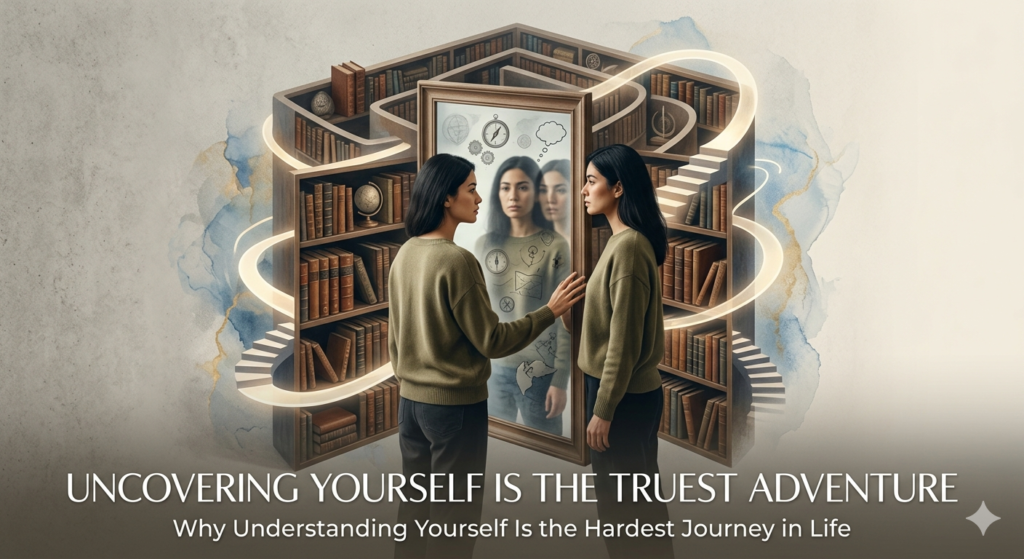
From Childhood, We Are Taught Who To Be — Not Who We Are
A child enters the world naturally authentic. A child laughs freely, cries honestly, expresses emotions openly, and exists without psychological masks. Yet very early in life, society begins teaching that child which emotions are acceptable and which parts of the self must be hidden.
Parents may unknowingly reward obedience more than authenticity. Schools compare children through grades and performance, while society subtly teaches that worth depends on achievement, appearance, popularity, or success. Slowly, the child learns that being accepted is often more important than being real.
Psychologist Carl Rogers, one of the pioneers of humanistic psychology, described this conflict through the idea of the “real self” and the “ideal self.” According to his research, emotional suffering often begins when people become disconnected from their authentic nature while trying to meet external expectations.
This is where the false self begins forming. People become performers long before they become conscious human beings.
A boy may suppress vulnerability because he is told that “real men do not cry.” A girl may suppress anger because she is expected to remain agreeable and emotionally pleasing. Over time, these repeated suppressions create personalities that are socially functional but internally fragmented.
Many adults today are not exhausted because of work alone. They are exhausted because maintaining a socially acceptable identity consumes enormous psychological energy.
The deeper we understand ourselves, the more we encounter questions about consciousness, karma, spiritual awakening, and the hidden dimensions of human experience. These ancient perspectives are explored further in Beyond Religion: The Ancient Inner Sciences Of Tantra, Kundalini, Karma, And Akashic Records Explained.
Why Understanding Yourself Feels So Painful
Most people believe self-discovery is a beautiful spiritual experience filled with peace and clarity. In reality, genuine self-awareness often begins with discomfort.
Understanding yourself means confronting painful truths. It means recognizing insecurity beneath confidence, loneliness beneath social activity, and fear beneath ambition. Many people spend years distracting themselves, not because they enjoy distraction, but because silence forces them to encounter unresolved emotions.
Modern society has created endless ways to avoid inner confrontation. Social media, constant entertainment, endless scrolling, and perpetual busyness protect people from sitting quietly with themselves. Noise has become a psychological shield.
The human mind fears stillness because stillness exposes emotional wounds that distraction temporarily hides.
According to research published by the American Psychological Association, excessive social comparison and validation-seeking behaviors on social media are strongly associated with anxiety, depression, low self-esteem, and emotional dissatisfaction. Many individuals unknowingly begin measuring their worth through external reactions rather than internal stability.
A fascinating study conducted at the University of Virginia found that many participants preferred mild electric shocks over sitting alone quietly with their thoughts for just a few minutes. The study revealed how deeply uncomfortable many human beings are with unfiltered self-confrontation.
This is not because people are weak. It is because most individuals have spent their entire lives avoiding emotional realities they were never taught how to process.
The Human Mind Creates Identities To Survive
The ego is not inherently evil. Psychologically, it develops as a survival mechanism.
Human beings create identities to feel secure in a world filled with uncertainty. Some people attach themselves to success, others to attractiveness, intelligence, spirituality, relationships, or social status. These identities provide temporary emotional stability because they answer the terrifying question: “Who am I?”
But the problem begins when identity becomes dependency.
A person who builds identity entirely around success may collapse emotionally after failure. Someone whose self-worth depends on relationships may feel psychologically destroyed after rejection. The mind becomes imprisoned by the very labels it created for protection.
This is why existential crises often emerge during major life changes. Retirement, divorce, heartbreak, failure, aging, or loss can suddenly dismantle identities people spent decades constructing.
Swiss psychiatrist Carl Jung believed that much of human suffering comes from living disconnected from the deeper unconscious self. His concept of “individuation” described the lifelong process of integrating hidden aspects of the personality in order to become psychologically whole.
In spiritual traditions across Buddhism, Vedanta, and mystical philosophy, this idea appears repeatedly. The suffering self is often described as a constructed identity rather than the deepest essence of consciousness.
Why We Constantly Seek Validation
One of the most emotionally revealing truths about human psychology is that many people do not seek love as much as they seek confirmation that they are worthy of love.
Validation temporarily fills internal incompleteness. Compliments, attention, social approval, and recognition create brief emotional highs because they momentarily silence deeper insecurities. Yet external validation never lasts long because the inner emptiness that produced the craving remains unresolved.
This explains why some individuals become emotionally dependent on praise. Even successful people may feel internally fragile when validation disappears.
A powerful example of this can be seen in celebrity psychology. Numerous globally admired actors, musicians, and influencers have publicly discussed experiencing depression, anxiety, and emptiness despite receiving enormous admiration from millions. External applause often fails to heal internal fragmentation.
One deeply studied case was that of actor Robin Williams. Despite being one of the most beloved entertainers in the world, his inner struggles reflected an important psychological truth: external success and internal peace are not the same thing.
Psychologists often describe this phenomenon as the “hedonic treadmill,” where human beings continuously chase emotional satisfaction externally without achieving lasting fulfillment. The mind adapts quickly to praise, success, and recognition, creating the need for even more validation.
Social media has intensified this psychological cycle dramatically. Many individuals now subconsciously associate self-worth with likes, views, comments, and digital attention. Human identity is increasingly becoming performance-oriented rather than authenticity-oriented.
The Terrifying Moment Of Real Self-Awareness
True self-awareness is not merely discovering strengths. It is seeing the hidden motivations behind behavior.
It is realizing that many ambitions were driven by fear of insignificance. It is understanding that certain relationships were maintained out of emotional dependency rather than love. It is seeing how often pride was actually insecurity wearing confidence as a disguise.
This realization can feel emotionally devastating because illusions begin collapsing.
Many spiritual traditions describe this stage as a form of psychological death. The old identity weakens, and the mind experiences confusion because the familiar self-image no longer feels stable.
Yet this painful confrontation is also deeply liberating.
Self-awareness becomes transformative when it leads to higher states of consciousness. Discover how awakening Kutastha (Christ Consciousness) naturally creates inner peace and authentic human magnetism.
Once individuals begin seeing themselves clearly, they slowly stop blaming the world for every emotional struggle. They stop needing constant approval. They stop performing endlessly for acceptance. For the first time, they begin existing more honestly.
Psychotherapist Dr. Irvin Yalom, known for his work on existential psychology, repeatedly emphasized that confronting existential truths — mortality, loneliness, meaninglessness, and identity — often produces deep anxiety initially but can eventually lead to profound psychological freedom.
This is why many people who undergo intense life crises later describe those experiences as transformative. Pain sometimes destroys illusions that comfort could never remove.

Case Study: Viktor Frankl And The Discovery Of Inner Meaning
One of the most profound real-life examples of self-understanding comes from psychiatrist Viktor Frankl, author of Man’s Search for Meaning.
Frankl survived Nazi concentration camps during World War II, where he witnessed unimaginable suffering. Yet through those experiences, he discovered something psychologically revolutionary: human beings can lose everything externally and still retain inner meaning.
Frankl observed that individuals who possessed a deeper sense of purpose were often psychologically more resilient than those who depended entirely on external conditions for emotional stability.
His work eventually led to the development of Logotherapy, a psychological approach centered on meaning rather than pleasure or power. Frankl’s insights continue to influence psychotherapy, trauma studies, and existential psychology worldwide.
The deeper lesson from his life is extraordinary. True inner strength often emerges only after false identities collapse.
Much of what we consider our personality is often built from social conditioning and external labels. This idea is explored further in our article on Why Some Spiritual Traditions Reject Clothing: which examines how ancient seekers attempted to move beyond identity itself.
The Great Paradox: The Day You Understand Yourself, You No Longer Need Yourself
This idea may sound strange initially, but it contains profound psychological and spiritual truth.
The day you truly understand yourself, the version of yourself built entirely around fear, comparison, insecurity, ego, and validation begins losing its control. The false self weakens because awareness exposes its illusions.
You no longer feel compelled to constantly prove your worth. You stop obsessively defending your image. You stop comparing your journey with everyone else’s life.
The self that constantly demanded validation was never your deepest nature to begin with.
This does not mean becoming emotionless or detached from life. It means becoming less psychologically imprisoned by identity. Inner peace slowly emerges because emotional survival is no longer dependent on external approval.
Buddhist philosophy often describes suffering as attachment to the constructed self. Similarly, Advaita Vedanta speaks of transcending ego-identification to recognize deeper consciousness beyond temporary personality structures.
In simpler words, peace begins where psychological performance ends.
Why Most People Never Reach This Stage
Modern society rewards image more than introspection.
People are taught how to build careers, attract attention, increase productivity, and compete socially. Very few are taught how to process grief, understand fear, sit with silence, or examine their inner world honestly.
The world often celebrates external achievement while quietly neglecting emotional maturity.
This is why many individuals appear successful outwardly yet feel deeply lost internally. Emotional emptiness cannot always be solved through money, relationships, popularity, or achievement because the root problem often lies in disconnection from the self.
Many people continue avoiding deep self-awareness throughout their lives because confronting the inner world can initially feel terrifying. The false self may be painful, but it also feels familiar.
Yet the cost of avoiding self-understanding is immense. A person may spend an entire lifetime performing for acceptance without ever experiencing inner freedom.
Ancient spiritual traditions suggest that genuine self-understanding begins when we learn to observe the silent witness behind our thoughts, a concept closely related to Turiya, the Fourth State of Consciousness.
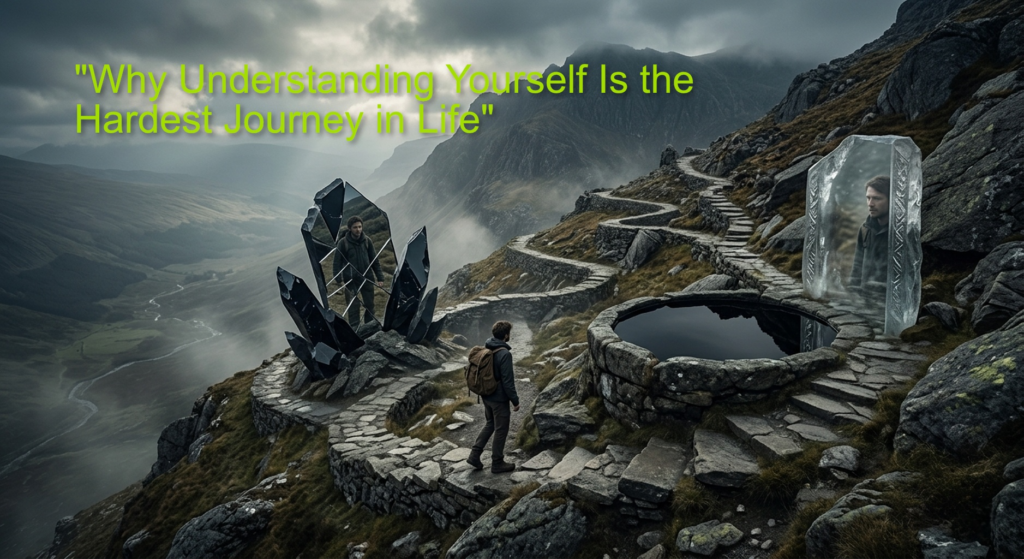
The Beauty Of Finally Becoming Comfortable With Yourself
There is a quiet peace that emerges when a person no longer needs to constantly defend their identity.
You stop trying to impress everyone. You stop chasing every form of approval. You stop measuring your worth through comparison. Gradually, life becomes less about performance and more about presence.
You begin appreciating solitude rather than fearing it. Silence becomes healing instead of uncomfortable. Relationships become more authentic because they are no longer built entirely upon emotional dependency.
Perhaps this is true emotional maturity — not becoming somebody extraordinary in the eyes of the world, but finally becoming comfortable enough to stop running away from yourself.
The greatest freedom in life may not be discovering how important you are. It may be realizing that your deepest peace begins the moment you no longer need constant confirmation of your importance.
And perhaps that is why the day you truly understand yourself, you no longer require the false version of yourself you spent your whole life protecting.
Related Reads
- The Gateway To Super-Consciousness: The Profound Spiritual Significance Of The Medulla Oblongata
- When Peace Begins To Isolate You: The Silent Paradox Of Meditation, Solitude And Human Transformation
- Transcending Boundaries: A Profound Exploration of Nirvikalpa Samadhi
- Can Kundalini Awakening Open The Door To Higher Consciousness?
- Why Loneliness Sometimes Becomes The Beginning Of Spiritual Awakening
- The Hidden Psychological Reason Why Humans Crave Validation
- How Silence Changes Human Consciousness And Emotional Healing
- The Strange Relationship Between Ego, Suffering, And Inner Peace
- Why Emotional Detachment Is Often Misunderstood In Spiritual Growth
- The Deep Connection Between Solitude, Meditation, And Self-Discovery
Hashtags
#UnderstandingYourself #SelfAwareness #SelfDiscovery #InnerPeace #SpiritualAwakening #EmotionalHealing #IdentityCrisis #TrueSelf #Psychology #Consciousness #MentalHealth #HumanNature #Meditation #Existentialism #PersonalGrowth #EmotionalMaturity #HealingJourney #Mindfulness #SelfRealization #EastsideWriters



Pingback: When Peace Begins to Isolate You: The Silent Paradox Between Solitude and Loneliness - Eastside Writers
Pingback: The Gateway To Super-Consciousness: The Profound Spiritual Significance Of The Medulla Oblongata - Eastside Writers
Pingback: Learning Tantra Meditation to awaken Kundalini in you - Eastside Writers
Pingback: Transcending Boundaries: A Profound Exploration of Nirvikalpa Samadhi and the Essence of Ultimate Consciousness - Eastside Writers
Pingback: Why Modern Homes Feel Emotionally Exhausted—Where Peace Has Gone - Eastside Writers
Pingback: Can LSD Create Higher Consciousness or Just a Floating Sensation? Understanding Turiya, the Fourth State of Consciousness - Eastside Writers
Pingback: Why Do We Take Birth Again and Again? A Deep Dive into Karma, Maya, and Moksha - Eastside Writers