
A few years ago, I was listening to a talk by Swami Sukhabodhananda, and he shared a simple story that has stayed with me ever since.
One evening, a lady was searching frantically under a street lamp. Seeing her distress, a few people stopped to help. Soon more people joined in. Before long, a small crowd had gathered, all searching for something.
Interestingly, most of them never even asked what she was looking for. They simply assumed that because she was searching desperately, they should help.
After some time, a young man arrived and asked, “What exactly are all of you searching for?”
The people replied, “We are helping this lady find something she has lost.”
The young man turned to the lady and asked, “What have you lost?”
“My house key,” she replied.
“Where did you lose it?” he asked.
“Inside my house.”
The young man looked puzzled.
“If you lost the key inside your house, why are you searching out here under the lamp?”
The lady replied, “Because there is no light inside the house. It is dark there. Here there is plenty of light, so I am searching here.”
It sounds funny. Yet if we are honest, most of us spend our entire lives doing exactly the same thing.
We search for happiness in achievements, peace in possessions, security in money, love in relationships, and fulfillment in external success. We search everywhere except the one place where the sages tell us the answer truly lies—within ourselves.
The great spiritual traditions of India have been pointing to this truth for thousands of years. The Upanishads, the Bhagavad Gita, and the teachings of countless sages repeatedly remind us that the deepest questions of life cannot be answered merely by looking outside.
And perhaps this leads us to one of the greatest questions of all.
Why are we here?
Why do we take birth?
Why do we experience joy and suffering, success and failure, love and loss?
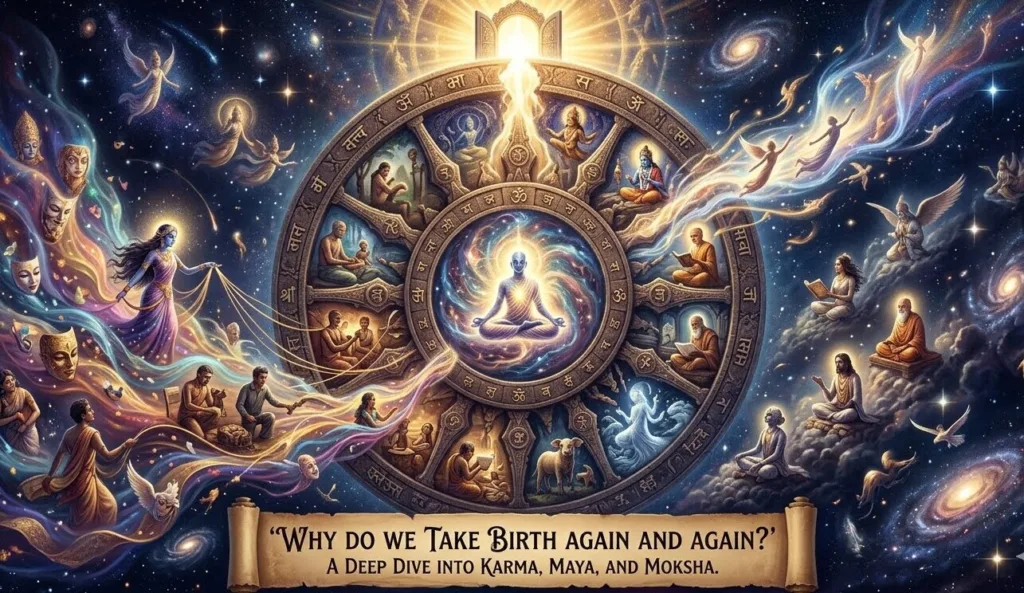
And if the soul is eternal, why does it keep returning to this world again and again?
The World of Maya
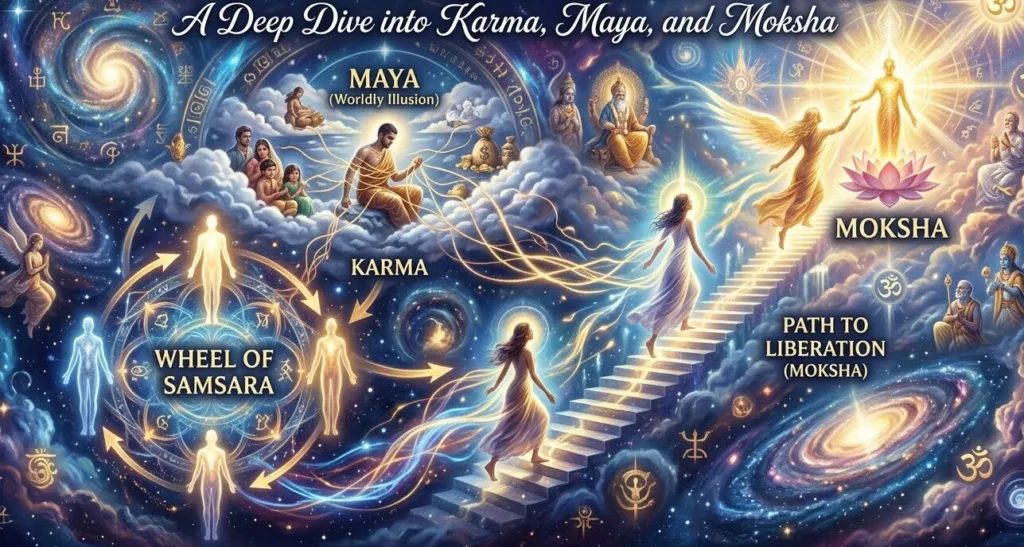
According to Indian spiritual philosophy, one of the primary reasons we struggle to answer these questions is because we live under the influence of Maya.
Maya is often translated as illusion, but that translation can be misleading.
Maya does not mean that the world does not exist. Rather, it means that we do not see reality as it truly is.
When a rope is mistaken for a snake in dim light, the rope exists, and the snake exists only in perception. The mistake lies not in reality but in the way reality is interpreted.
Similarly, we begin to identify ourselves with our body, our emotions, our thoughts, our achievements, our failures, our social status, and countless other temporary things. Gradually, we forget our deeper nature.
From childhood onward, we learn thousands of things about the external world. We learn mathematics, science, history, business, technology, and language. Yet very few of us ever learn the answer to the most fundamental question:
Who am I?
Am I merely this body?
Am I merely this mind?
Am I simply a collection of memories and experiences?
Or is there something deeper that remains unchanged beneath all of these?
The sages of India answered this question very clearly.
You are not the body.
You are not the mind.
You are not even the constantly changing stream of thoughts and emotions.
At your deepest level, you are the Atman—the eternal consciousness that witnesses all experiences.
Understanding the Subtle Body
If this is true, another question naturally arises.
If we are the soul, then what exactly is this mind that constantly thinks, desires, fears, judges, remembers, and worries?
Indian philosophy provides a fascinating answer.
Human existence is not limited to the physical body. According to Vedanta, there are multiple layers of existence.
The physical body is called the Sthula Sharira or gross body.
Beyond it exists the Sukshma Sharira, or subtle body.
The subtle body acts as a bridge between the eternal soul and the physical world. It is through the subtle body that we think, feel, desire, imagine, remember, and experience life.
The subtle body consists of four primary components known collectively as the Antahkarana, or Inner Instrument.
The first is Manas, the mind that receives sensory impressions and generates emotions, reactions, and desires.
The second is Buddhi, the intellect that reasons, analyzes, and makes decisions.
The third is Ahamkara, the ego, which creates the sense of “I” and “mine.”
The fourth is Chitta, the storehouse of memories, impressions, habits, and subconscious tendencies.
Together, these four create the psychological personality that we ordinarily think of as ourselves.
Yet according to the sages, even these are not our true identity.
They are merely instruments through which consciousness expresses itself.
The Hidden Storage of Karma
One of the most fascinating aspects of the subtle body is its relationship with karma.
Many people think of karma as a system of reward and punishment.
The ancient texts present a much more nuanced view.
Every thought, every action, every intention, and every emotional reaction leaves an impression upon the subtle body. These impressions are called Samskaras.
Think of them as grooves in consciousness.
The more often a pattern is repeated, the deeper the groove becomes.
Repeated anger creates a tendency toward anger.
Repeated compassion creates a tendency toward compassion.
Repeated fear creates a tendency toward fear.
Repeated courage creates a tendency toward courage.
Over time, these impressions form our personality, our preferences, our strengths, our weaknesses, and many of the patterns we carry through life.
Karma does not merely determine circumstances; it also shapes the conditioning of the mind. Learn how meditation gradually dissolves these impressions through the awakening of Kutastha Consciousness.
According to the doctrine of reincarnation, death removes the physical body, but the subtle body continues.
The Samskaras remain.
The tendencies remain.
The unfinished karmas remain.
And these become part of the blueprint that shapes future experiences.
The Three Functional Sheaths of the Subtle Body
The sages also described human existence through the framework of the five Koshas or sheaths.
Among these, three belong primarily to the subtle body.
The Pranamaya Kosha is the sheath of life force. It governs vitality, energy, breath, and the flow of prana throughout the system.
The Manomaya Kosha is the mental sheath. It includes thoughts, emotions, desires, fears, and reactions.
The Vijnanamaya Kosha is the sheath of higher intelligence and wisdom. It enables discrimination, ethical judgment, and spiritual insight.
These layers work together continuously.
Most people spend their lives functioning almost entirely within the first two layers. They react to circumstances, chase desires, avoid discomfort, and become trapped in endless mental activity.
The spiritual path begins when the Vijnanamaya Kosha starts becoming active.
That is the stage where a person begins asking deeper questions.
Who am I?
Why am I here?
What is the purpose of life?
Why do some experiences keep repeating?
Why do certain people enter my life?
And why does lasting happiness seem so difficult to find?
Interestingly, these questions themselves are signs of spiritual awakening.
Not because the answers have been found.
But because the search has finally begun in the right direction.
If the Soul Is Perfect, Why Does It Take Birth?
At this point, a thoughtful reader may raise an important objection.
If the soul is already pure, eternal, and perfect, why does it need to come here at all? Why take birth? Why go through countless experiences, struggles, and challenges? Why not simply remain in the higher realms?
This question has fascinated spiritual seekers for thousands of years.
The answer given by the Upanishads is subtle and often misunderstood.
The Atman, or the true Self, is indeed perfect. It is neither born nor does it die. It is not affected by success or failure, pleasure or pain. It remains what it has always been—pure consciousness.
However, the individual soul, known as the Jiva, identifies itself with the body, mind, emotions, and ego. This identification creates what the sages call Avidya, or ignorance.
Here we must be careful.
Ignorance does not mean a lack of information. A person may possess multiple degrees, speak several languages, and still remain ignorant in the spiritual sense.
Spiritual ignorance simply means not knowing who we truly are.
It is the mistaken belief that “I am this body.”
It is the mistaken belief that “I am my thoughts.”
It is the mistaken belief that happiness depends entirely upon external circumstances.
The Upanishads repeatedly state that this mistaken identity is the root of human suffering.
Learning or Remembering?
Many spiritual teachers describe life as a school where the soul comes to learn.
There is truth in this idea, but the ancient sages would perhaps phrase it differently.
According to Vedanta, the soul is not trying to become something it is not. Rather, it is gradually discovering what it has always been.
Imagine a prince who was separated from his family as a child and raised in a poor village. For years, he believed himself to be poor. One day someone reveals his true identity.
Did he become a prince on that day?
No.
He was always a prince.
What changed was his understanding.
Similarly, self-realization is not the creation of a new reality. It is the recognition of an existing one.
This is why many sages say that spiritual growth is less about learning and more about remembering.
Not remembering an event.
Not remembering a past life.
But remembering our true nature.
The knowledge already exists.
What is missing is direct realization.
The Role of the Physical Body
This brings us to another fascinating question.
If the subtle body carries our mind, intellect, ego, memories, and karmic impressions, why is a physical body necessary at all?
Why cannot the soul simply evolve in the subtle realms?
The answer given by many spiritual traditions is that potential alone is not enough.
A seed may contain an entire tree within it, but until it is planted in soil, exposed to sunlight, wind, storms, and seasons, its potential remains unrealized.
Similarly, the subtle body contains countless tendencies and karmic impressions.
But these tendencies need circumstances through which they can express themselves.
A person may believe they are patient until life presents them with difficulties.
A person may believe they are compassionate until they encounter suffering.
A person may believe they are detached until they face loss.
The physical world provides the field where latent tendencies become visible.
The Bhagavad Gita refers to this world as the Kshetra—the field of action.
It is here that karmic seeds sprout, grow, and eventually bear fruit.
Without experience, many tendencies would remain hidden.
Without challenges, growth would remain theoretical.
Without relationships, love would remain an idea rather than a lived reality.
The Causal Body and the Seeds of Karma
Beyond the physical and subtle bodies lies what Vedanta calls the Karana Sharira, or causal body.
This is perhaps the most mysterious aspect of human existence.
If the subtle body contains active thoughts, emotions, desires, and memories, the causal body contains the seeds from which these arise.
It is often compared to a vast storehouse of karmic potential.
Just as a tree exists in seed form before becoming visible, many of our future experiences exist in seed form within the causal body.
The causal body is not active in the way the mind is active.
It is a state of tremendous potential.
This is why some teachers compare it to dreamless sleep.
In dreams there is activity.
There are images, thoughts, emotions, and movement.
In deep dreamless sleep there is profound stillness.
Yet when we awaken, we often say, “I slept peacefully.”
Who experienced that peace?
This question has intrigued philosophers and mystics for centuries.
The sages suggest that deep sleep offers a tiny glimpse of a reality beyond the ordinary mind.
Why Do We Forget?
Another question naturally follows.
If our true nature is divine, why do we forget it in the first place?
The honest answer is that no philosophical explanation is entirely satisfying.
Even the great sages acknowledged that Maya is difficult to explain.
The Upanishads often describe it not as something that can be fully understood intellectually, but as something that must be transcended through direct experience.
Yet we can observe its effects.
We become absorbed in our roles.
We become attached to our possessions.
We become identified with our successes and failures.
Gradually the temporary begins to appear permanent.
The changing begins to appear unchanging.
The instrument begins to appear as the self.
This is Maya in action.
And this is why spiritual practice is ultimately a process of awakening rather than acquiring.
What Is Moksha Really?
Many people imagine Moksha as a heavenly destination somewhere beyond this world.
The sages describe it differently.
Moksha is freedom.
Freedom from ignorance.
Freedom from compulsive desires.
Freedom from fear.
Freedom from attachment to a false identity.
Most importantly, it is freedom from the belief that we are separate from the source of existence itself.
This is why self-realization is often described as indescribable.
Sri Ramakrishna Paramahamsa, along with many other realized masters, explained that the highest spiritual experiences cannot be adequately expressed through language.
Words belong to the mind.
The ultimate reality lies beyond the mind.
It can be experienced.
It can transform a person’s life completely.
But it cannot be fully captured in sentences.
Perhaps this is why every spiritual tradition eventually reaches a point where silence becomes more powerful than speech.
Returning to the Story of the Lost Key
And now we return to the story with which we began.
The woman searching under the street lamp represents all of us.
We search for happiness in possessions.
We search for security in wealth.
We search for identity in social status.
We search for fulfillment in achievements.
There is nothing wrong with these pursuits. They are part of human life.
The problem begins when we expect them to provide something they were never meant to provide.
The key was lost inside the house.
Yet the search continued outside because there was more light there.
Similarly, the peace we seek, the love we seek, the happiness we seek, and even the truth of who we are lie within.
But looking inward requires courage.
It requires self-observation.
It requires silence.
It requires us to confront aspects of ourselves that we often avoid.
And so we continue searching beneath the lamp.
The great sages, however, keep pointing us back toward the house.
Again and again they remind us that the purpose of life is not merely to accumulate experiences, possessions, or achievements.
The purpose is to awaken.
Whether we call it learning, remembering, evolving, or realizing ultimately does not matter.
What matters is that every experience in life can become a step toward greater awareness.
Perhaps that is why we take birth.
Not because the soul is imperfect.
Not because God is testing us.
Not because we are being punished.
But because through the mysterious play of karma, consciousness, and experience, we are given repeated opportunities to discover what has always been true.
The treasure was never outside.
The key was never outside.
The light we are searching for has always existed within.
The journey of life is simply the gradual realization of that eternal truth.
Further Reading on Eastside Writers
If the ideas of karma, reincarnation, consciousness, and spiritual awakening resonate with you, continue your journey with these related articles:
1. How Reincarnation Works and What Your Soul Experiences Between Lives
Explore what may happen between death and rebirth, and how karmic impressions influence the soul’s next journey.
2. What Does the Soul Experience During the First 13 Days After Death? Ancient Hindu Wisdom Explained
Discover the fascinating Hindu perspective on the soul’s journey immediately after death and before its onward passage.
3. Near-Death Experiences: Evidence or Illusion? The Chilling New Science That Changes Everything
A thought-provoking exploration of consciousness, death, and what modern research may reveal about life beyond the physical body.
4. Why Humans Fear Death: The Secret Reason We Chase Success, Love, and Legacy
If death is only a transition, why are human beings so afraid of it? This article explores the psychology and spirituality behind our deepest fear.
5. Can Meditation Reveal Your Past, Future, and Hidden Potential?
Can deeper states of meditation unlock memories, intuition, and hidden dimensions of consciousness? Explore the possibilities.
6. The Silent Power of Self-Awareness: Why Inner Observation Is the Beginning of Spiritual Growth
The journey toward Moksha begins with self-observation. Learn why awareness is the foundation of every authentic spiritual path.
7. Why Sexual Thoughts Arise During Meditation: The Science, Psychology, and Spiritual Perspective
A deeper look into the workings of the mind, Samskaras, and subconscious impressions that surface during meditation.
8. Why Did Ancient Yogis and Aghoris Call Virya (Semen) the Fuel of Enlightenment?
Understand how ancient yogic traditions viewed life-force energy, consciousness, and spiritual transformation.
9. The Difference Between Information and Wisdom in the Age of Constant Noise
Why intellectual knowledge alone cannot lead to self-realization, and how wisdom emerges through direct experience.
10. Why We Search for Happiness Outside When It Already Exists Within
A reflection on the same truth illustrated by the story of the woman searching for her lost key beneath the lamp.
Frequently Asked Questions (FAQs)
If the soul is already perfect, why does it take birth?
According to Vedanta, the soul itself is always pure and complete. Birth occurs because the individual self (Jiva) identifies with the body, mind, and ego. Through life experiences and spiritual awakening, this mistaken identification gradually dissolves.
Are we here to learn or to remember?
The ancient sages suggest that spiritual growth is less about acquiring new knowledge and more about recognizing our true nature. In that sense, life becomes a journey of remembrance rather than accumulation.
What is the biggest illusion in human life?
One of the greatest illusions is believing that lasting happiness can be found entirely in external circumstances. The Upanishads repeatedly point inward, teaching that peace and fulfillment arise from understanding our true nature.
How does karma influence our present life?
Karma is not simply reward and punishment. It is the accumulation of impressions created by our thoughts, actions, intentions, and choices. These impressions influence our tendencies, relationships, challenges, and opportunities.
What are Samskaras?
Samskaras are subtle mental impressions formed through repeated experiences. They shape our habits, emotional reactions, fears, desires, and personality traits, often operating below conscious awareness.
Why do similar life patterns keep repeating?
From a spiritual perspective, recurring patterns often indicate unresolved lessons, attachments, or karmic tendencies. Awareness is the first step toward transforming these patterns.
What is the difference between the mind and the soul?
The mind thinks, reacts, remembers, and changes constantly. The soul, according to the Upanishads, is the silent witness behind all experiences. Thoughts come and go, but the witnessing consciousness remains unchanged.
How does meditation help in spiritual growth?
Meditation helps quiet the constant activity of the mind. As mental noise decreases, deeper awareness emerges, allowing us to observe our thoughts, emotions, and conditioned patterns more clearly.
What is Moksha in simple terms?
Moksha is freedom from ignorance and the cycle of repeated birth and death. It is the direct realization of our true nature beyond the body, mind, and ego.
What is the ultimate purpose of human life?
Different traditions express it differently, but most Indian spiritual teachings point toward self-realization—awakening to the truth of who we really are and living from that awareness.
Reflection for Readers
If happiness, peace, and truth already exist within us, why do we spend so much of our lives searching for them outside ourselves? Perhaps the answer to that question is the beginning of the spiritual journey itself.
#Reincarnation #Karma #Maya #Moksha #Vedanta #Upanishads #BhagavadGita #Spirituality #SelfRealization #SoulJourney #Consciousness #Meditation #IndianPhilosophy #SpiritualGrowth #Enlightenment #PurposeOfLife

Pingback: How Reincarnation Works and What Your Soul Experiences Between Lives – Eastside Writers
Pingback: Why Sexual Thoughts Arise During Meditation: The Science, Psychology, and Spiritual Perspective – Eastside Writers
Pingback: Why Did Ancient Yogis and Aghoris Call Virya (Semen) the Fuel of Enlightenment? – Eastside Writers
Pingback: This Moment Is Nirvana: Osho’s Heart Sutra and the Revolution of Living Now – Eastside Writers
Pingback: How to Find Your True Self: A Simple Path to Higher Consciousness – Eastside Writers
Pingback: Exploring the Pursuit of Moksha and Samadhi in Life: Balancing Enjoyment and Spiritual Liberation – Eastside Writers
Pingback: Near-Death Experiences: Evidence or Illusion? The Chilling New Science That Changes Everything - Eastside Writers