
A few weeks ago, a friend asked me a question that many spiritual seekers have secretly asked themselves at some point:
“If I practice meditation or Kriya Yoga with complete dedication, discipline, and sincerity, will all my wishes eventually come true? Can I learn astral travel? Can I see my past lives, understand my karmic bondage, or even glimpse the future?”
At first glance, the question appears simple. Yet hidden within it are some of the oldest mysteries humanity has ever contemplated.
Across cultures and centuries, people have sought answers to the same fundamental questions. Are we limited to what we perceive through our senses? Is consciousness merely a product of the brain, or does it extend beyond it? Can deep spiritual practice reveal aspects of reality that remain hidden in ordinary life?
What makes these questions especially relevant today is that they are no longer being explored only by mystics and monks. Neuroscientists, psychologists, consciousness researchers, and metaphysical thinkers are all investigating similar territory from different directions.
The fascinating part is that while they often use different language, they may be circling around the same mystery.
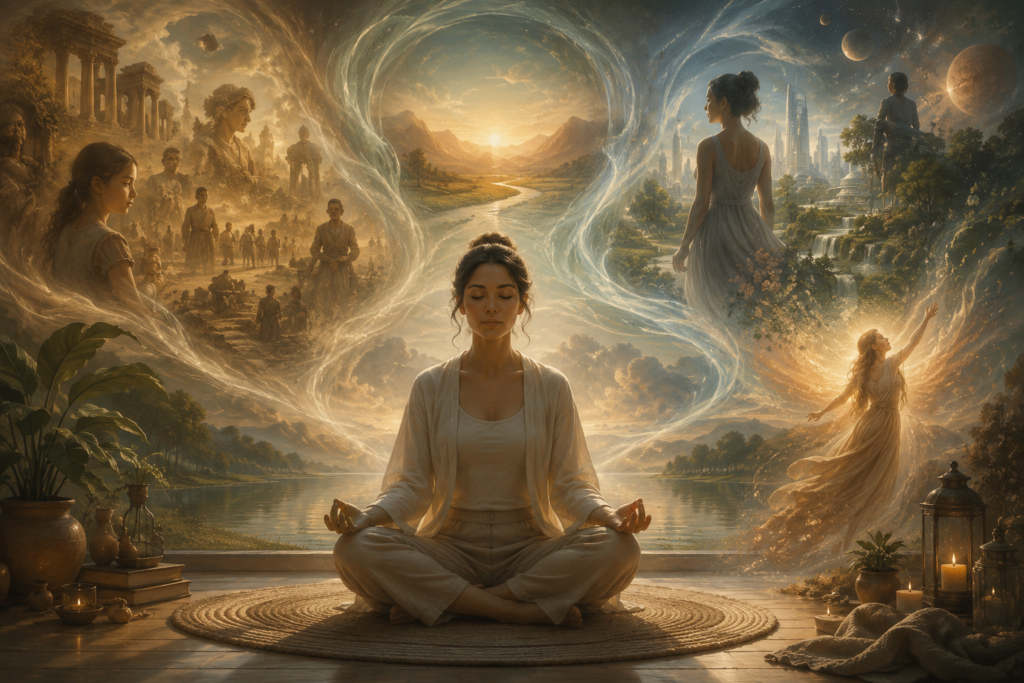
The Modern Spiritual Dream: Meditation as a Gateway to Extraordinary Abilities
Many people begin meditation hoping for peace, clarity, or stress relief. Yet beneath these practical goals often lies a deeper curiosity.
Can meditation unlock hidden human potential?
This curiosity has been amplified by books, documentaries, podcasts, and personal testimonies describing experiences such as:
- Astral projection
- Past-life memories
- Profound intuition
- Synchronicities
- Out-of-body experiences
- Deep states of bliss
- Unexplained healing
- Expanded awareness
Stories like these naturally capture attention because they challenge our conventional understanding of reality.
Books such as Many Lives, Many Masters by Dr. Brian Weiss introduced millions of readers to the possibility that consciousness may carry memories beyond a single lifetime. Similarly, Dr. Joe Dispenza’s work has popularized the idea that profound changes in consciousness may influence not only mental states but also physical reality itself.
Yet before asking whether such experiences are possible, a more important question must be addressed:
What is meditation actually designed to do?
What Meditation Was Originally Meant For
Most traditional spiritual systems did not develop meditation as a method for acquiring extraordinary powers.
The primary purpose was far simpler—and far deeper.
Meditation was intended to help human beings understand the nature of their own consciousness.
In the yogic traditions of India, the problem was never that people lacked experiences. Human beings are constantly having experiences.
The problem was identification.
We identify with our thoughts, emotions, fears, desires, memories, and expectations so completely that we rarely stop to question who is experiencing them.
Meditation begins to loosen this identification.
As attention becomes more stable, something interesting happens:
The mind becomes quieter.
The constant stream of internal commentary starts losing its dominance.
Awareness becomes less entangled with every passing thought.
This transformation may sound subtle, but it changes the entire structure of perception.
Ironically, the deeper one goes into meditation, the less obsessed one becomes with acquiring special experiences.
What the Upanishads Actually Suggest
The ancient Upanishads offer an intriguing perspective on this subject.
Modern seekers often ask:
“What can I gain through spiritual practice?”
The Upanishads quietly reverse the question.
Instead of asking what can be gained, they ask:
“Who is the one seeking gain?”
This shift changes everything.
The Upanishadic sages were not primarily interested in supernatural experiences. They were interested in discovering the nature of consciousness itself.
Their central insight was revolutionary.
The deepest reality is not something that appears in consciousness. It is consciousness itself.
From this perspective, visions, psychic experiences, astral journeys, and mystical states may all be interesting, but they are still experiences that arise and disappear.
The true inquiry concerns that which remains present before, during, and after every experience.
This is why many Upanishadic teachings focus less on extraordinary phenomena and more on self-realization.
The implication is profound.
Perhaps the greatest mystery is not whether we can travel beyond the body.
Perhaps it is understanding what we truly are before we identify with the body in the first place.
Why Experiences Like Astral Travel and Past-Life Memories Are Reported
Despite the caution of the Upanishads, reports of unusual experiences continue to emerge across cultures and traditions.
Many meditators describe:
- Feeling separated from the physical body
- Perceiving symbolic visions
- Experiencing encounters with deceased relatives
- Reliving scenes that feel like past lives
- Receiving intuitive insights that later prove meaningful
What should we make of these accounts?
One possibility is psychological.
As sensory input decreases and attention becomes highly concentrated, the mind begins accessing layers of memory, symbolism, and imagination that are usually hidden beneath everyday activity.
Another possibility is that consciousness may possess dimensions that modern science does not yet fully understand.
The honest answer is that no consensus currently exists.
Both possibilities remain open.
What matters is recognizing that unusual experiences do not automatically prove a particular metaphysical theory.
Nor do they automatically invalidate one.
Dr. Brian Weiss and the Mystery of Deep Karmic Healing
One of the most influential figures in this discussion is Dr. Brian Weiss.
While working as a psychiatrist, Weiss encountered patients who appeared to access memories that did not seem connected to their current lives.
These experiences eventually became the foundation of his bestselling book Many Lives, Many Masters.
Whether one interprets these sessions as genuine past-life memories, symbolic subconscious narratives, or therapeutic constructs, an interesting pattern emerged.
Many participants reported profound emotional healing.
Long-standing fears diminished.
Unexplained anxieties softened.
Persistent emotional burdens seemed to lose their intensity.
This raises an important question.
Could human suffering sometimes be connected to deeper layers of memory than conventional psychology currently recognizes?
Ancient Indian traditions would not find this possibility surprising.
The concept of karma has always suggested that the human psyche carries impressions, tendencies, and unresolved patterns that influence present experience.
The debate remains open.
Yet the therapeutic implications are difficult to ignore.
Brain Mapping, Gamma Waves, and the Search for Super Consciousness
While spiritual traditions explored consciousness through direct experience, modern science has approached the same mystery through measurement.
Researchers studying long-term meditators have observed fascinating neurological changes.
Brain imaging studies have revealed:
- Greater neural coherence
- Reduced activity in self-referential networks
- Increased emotional regulation
- Enhanced attention control
- Elevated gamma wave activity in some advanced practitioners
These findings suggest that meditation significantly alters how the brain functions.
However, they also reveal an important limitation.
Scientists can measure electrical activity.
They cannot directly measure consciousness itself.
An EEG can show changes in brain waves.
An fMRI can show shifts in blood flow.
Neither can fully explain subjective awareness.
This distinction is crucial.
The map is not the territory.
The brain may be deeply involved in consciousness, but whether it completely produces consciousness remains one of the most debated questions in modern science.

The Emerging Field of Consciousness Research
In recent years, consciousness has become one of the most fascinating frontiers in science and philosophy.
Researchers from fields as diverse as neuroscience, quantum theory, psychology, cognitive science, and philosophy continue to wrestle with a problem often called “the hard problem of consciousness.”
Why does subjective experience exist at all?
How does matter generate awareness?
Or does it?
Some researchers argue that consciousness emerges from complex brain activity.
Others suggest that consciousness may be a fundamental feature of reality itself.
Interestingly, this latter possibility resembles certain ideas found in the Upanishads thousands of years ago.
While the language differs dramatically, both perspectives challenge the assumption that consciousness is merely an accidental by-product of biology.
Joe Dispenza, Neuroplasticity, and the Metaphysical Question
Dr. Joe Dispenza’s work sits at an unusual intersection between neuroscience, spirituality, and metaphysics.
His central argument is that sustained changes in thought, emotion, and attention can reshape both the brain and personal experience.
Many of his teachings draw upon established concepts such as neuroplasticity—the brain’s ability to reorganize itself through repeated patterns of thought and behavior.
Where debate emerges is in his broader suggestion that consciousness may influence reality in ways that conventional science does not yet fully explain.
Supporters view this as a bold exploration of human potential.
Critics argue that some claims extend beyond available evidence.
Regardless of one’s position, Dispenza’s popularity highlights a growing cultural shift.
People are no longer satisfied with viewing consciousness as merely a biological side effect.
They want to understand its stronger possibilities.
Can Meditation Help Fulfill Your Wishes?
This brings us back to the original question.
Can meditation make your wishes come true?
The answer depends entirely on what is meant by the question.
Meditation is not a magical vending machine for desires.
However, it can profoundly change the person who is making those desires.
When attention becomes clearer:
- Decisions improve
- Emotional reactivity decreases
- Self-sabotaging patterns become visible
- Focus increases
- Priorities become clearer
As a result, many goals become easier to achieve.
From the outside, this can appear as though meditation has somehow manifested outcomes.
In reality, the practitioner has simply become more aligned, less distracted, and more intentional.
The wish changes because the person making the wish changes.
Karma, the Future, and the Limits of Prediction
Many seekers hope meditation will reveal their future.
Yet most classical Indian traditions describe the future not as a fixed destination but as a field of possibilities.
Karma is better understood as momentum than destiny.
Every action, thought, habit, and choice contributes to future probabilities.
Meditation can increase awareness of these patterns.
It can help a person see where their current trajectory is leading.
But that is very different from possessing a supernatural preview of future events.
Greater awareness may improve foresight.
It does not necessarily grant prophecy.
The Real Transformation Hidden Behind the Question
Perhaps the most interesting discovery made by long-term practitioners is this:
The deeper meditation becomes, the less important extraordinary abilities appear.
What initially attracts many people to spiritual practice is the possibility of gaining something.
What often keeps them practicing is the gradual realization that freedom comes from letting go rather than accumulating.
The desire to know the future softens.
The obsession with powers weakens.
The need for certainty begins to dissolve.
In its place emerges something quieter.
Clarity.
Presence.
A deeper relationship with reality as it is.

Conclusion
So, can meditation reveal your past, future, hidden potential, or even dimensions of consciousness that lie beyond ordinary perception?
Perhaps.
History, spirituality, psychology, neuroscience, and metaphysical research all contain observations that prevent a simple dismissal of such possibilities.
Yet the deeper lesson may lie elsewhere.
The greatest transformation reported by sincere practitioners is rarely the acquisition of powers.
It is the transformation of perception itself.
The ancient yogis, the Upanishadic sages, modern neuroscientists, consciousness researchers, Dr. Brian Weiss, and even contemporary thinkers like Dr. Joe Dispenza may disagree on many details.
But they all point toward one enduring mystery:
Human consciousness appears far deeper than our everyday experience suggests.
And perhaps the most profound question is not whether meditation can reveal hidden realities.
Perhaps the real question is whether our ordinary understanding of reality has been incomplete all along.
📚 Further Reads
Consciousness & Philosophy
- Stanford Encyclopedia of Philosophy – Consciousness
- Stanford Encyclopedia of Philosophy – Indian Philosophy
- Internet Encyclopedia of Philosophy – Mind & Consciousness
Classical Spiritual Texts
- Upanishads (Sacred Texts Archive)
- Bhagavad Gita (Sacred Texts Archive)
- Yoga Sutras of Patanjali (Sacred Texts Archive)
Modern Consciousness & Therapy
- Many Lives, Many Masters – Dr. Brian Weiss
- Same Soul, Many Bodies – Dr. Brian Weiss
- Becoming Supernatural – Dr. Joe Dispenza
- Breaking the Habit of Being Yourself – Dr. Joe Dispenza
Research Areas
- Neuroplasticity and Meditation Studies
- EEG Gamma Wave Research in Meditators
- Consciousness and Brain-Body Interaction Studies
FAQs
- Can meditation reveal past lives?
Meditation and regression practices sometimes produce experiences interpreted as past lives. However, interpretations vary between spiritual, psychological, and scientific perspectives.
- Can Kriya Yoga give supernatural powers?
Traditional texts mention siddhis, but they are considered side effects, not goals. The main aim of Kriya Yoga is self-realization and inner transformation.
- Does meditation allow astral travel?
Many practitioners report out-of-body-like experiences, but there is no scientific confirmation that these are literal astral journeys.
- Can meditation help predict the future?
Meditation improves awareness, intuition, and clarity, which may help decision-making, but it does not provide literal future prediction.
- What do Upanishads say about spiritual experiences?
Upanishads emphasize self-realization over experiences. All phenomena are considered temporary compared to pure awareness.
- What is super consciousness in meditation?
It refers to expanded awareness states beyond ordinary thought, interpreted differently across neuroscience, spirituality, and metaphysics.
- Is consciousness produced by the brain?
Science suggests strong correlation, while philosophical traditions like the Upanishads propose consciousness may be fundamental rather than produced.
#Meditation, #KriyaYoga, #Consciousness, #Spirituality, #Upanishads, #Mindfulness, #BrainScience, #Neuroscience, #JoeDispenza, #BrianWeiss, #AstralProjection, #PastLives, #Karma, #SpiritualAwakening, #InnerTransformation, #SelfAwareness, #PhilosophyOfMind, #Neuroplasticity, #EasternPhilosophy, #YogaPhilosophy, #MeditationPractice, #ConsciousLiving


Pingback: Subtle Bodies-The Importance And Consequences Of Subtle Body
Pingback: Why Did Ancient Yogis and Aghoris Call Virya (Semen) the Fuel of Enlightenment? - Eastside Writers
Pingback: Why Sexual Thoughts Arise During Meditation: The Science, Psychology, and Spiritual Perspective - Eastside Writers
Pingback: Can LSD Create Higher Consciousness or Just a Floating Sensation? Understanding Turiya, the Fourth State of Consciousness - Eastside Writers
Pingback: Beyond Religion: The Ancient Inner Sciences Of Tantra, Kundalini, Karma, And Akashic Records Explained - Eastside Writers
Pingback: Why Your Mind Resists Growth: From Meditation to Desire, the Hidden Pattern Controlling Your Life - Eastside Writers
Pingback: Why Meditation Fails for Most People: The Hidden Struggle No One Talks About - Eastside Writers
Pingback: 🌿 The Power of Now — A Realistic Reflection from a Practical Reader - Eastside Writers
Pingback: The Life We Keep Waiting For: What Manifestation Really Means - Eastside Writers