
Part 1: Who Is Really Bound?
Editor’s Note
This article is the first installment of a two-part series exploring one of Sri Ramakrishna Paramahamsa’s most profound teachings on karma. In this first part, we examine why most people ask the wrong question about karma and unknowingly carry a burden that was never theirs. In the concluding article, we shall explore witness consciousness, the mystery of deep sleep, and why your true Self has never been touched by karma.
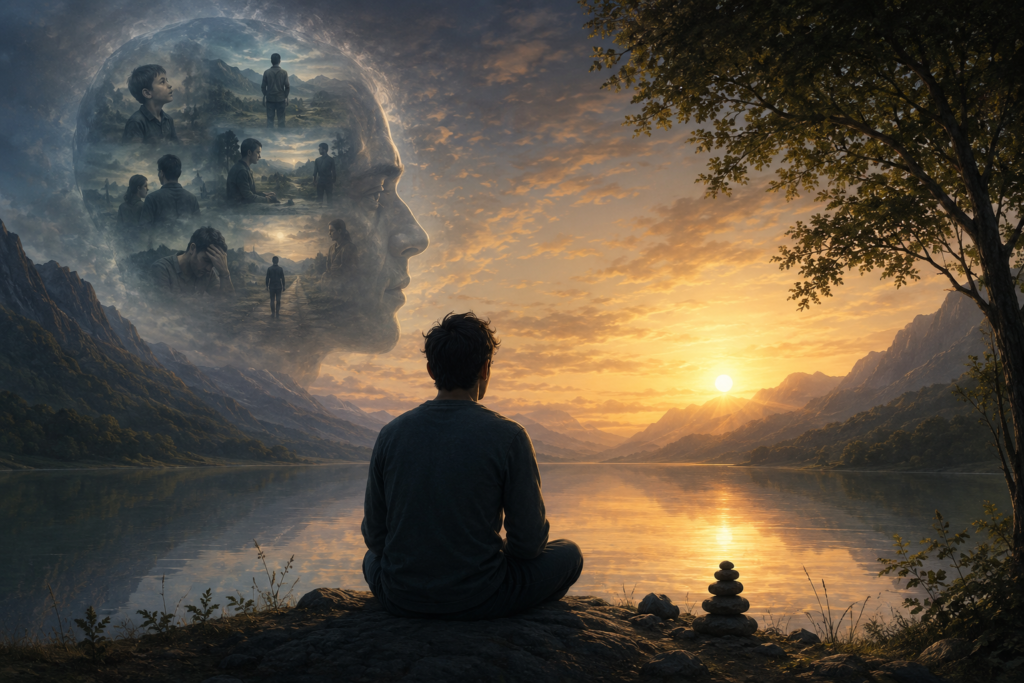
Have You Ever Wanted to Escape Your Own Past?
Most of us have. Not because we dislike life, but because there are moments we wish had never happened. A wrong decision, a broken relationship, a harsh word spoken in anger, or an opportunity we failed to recognise—these memories often linger far longer than the events themselves.
Years pass, and life moves forward, yet the mind quietly walks back to those old chapters. It keeps replaying conversations, questioning decisions, and imagining different endings. Slowly, the past stops being a memory and becomes an identity.
Many people call this karma. They believe every setback, every disappointment, and every recurring struggle is the inevitable consequence of something they once did. The invisible weight feels so real that they spend years searching for ways to get rid of it.
They pray with devotion. They perform rituals with sincerity. They meditate, fast, visit sacred places, donate to charity, and seek the blessings of saints. Beneath all these spiritual efforts lies one silent hope—that somehow the burden of karma will finally come to an end.
But what if we have misunderstood the problem itself? What if karma is not the prison we imagine it to be? What if the real prison is the unquestioned belief that “I am the one carrying it”?
That is precisely where Sri Ramakrishna Paramahamsa begins. Instead of teaching people how to escape karma, he gently invites them to examine the one who believes he is trapped by it.
The Question That Changes Everything
Whenever life becomes difficult, our attention immediately turns to the problem. We ask why suffering has entered our lives, why certain patterns keep repeating, or what we must do to erase the effects of our past actions. These questions are natural because they arise from our desire to be free.
Yet Sri Ramakrishna quietly redirected the entire conversation. Before speaking about karma, he asked a question that few spiritual seekers ever think to ask.
Who is the one that believes he is bound?
At first, the answer seems obvious. I am bound. I made the mistakes. I am facing the consequences. But are we certain that we know who this “I” really is?
Most of us never pause to investigate it. We assume we know ourselves simply because we use the word “I” every day. Sri Ramakrishna invites us to look much more deeply, because the answer to that one question determines how we understand every other aspect of spiritual life.
Are You the Same Person You Were Twenty Years Ago?
Think back to your childhood. The little boy or girl you once were had a different body, different thoughts, different fears, and different dreams. The world looked completely different through those young eyes.
Now compare that child with the person reading these words today. Your body has changed beyond recognition. Your beliefs have evolved. Your ambitions have shifted. Even the people who once seemed indispensable may no longer be part of your life.
Everything appears to have changed, yet one curious fact remains. Without hesitation, you still say, “That child was me.” How can that be true when almost everything about you is different?
This is not merely a philosophical puzzle. It is one of the most important questions we can ask. If the body changes, the mind changes, and the personality changes, what is it that has remained constant through every stage of your life?
Sri Ramakrishna did not ask this question to confuse his listeners. He asked it because the answer quietly opens the first door to freedom.
The Silent Companion You Have Never Noticed
Think about every important moment of your life.
Your first day at school. Your first success. Your first heartbreak. The day you got married. The day you lost someone you loved. Every joy and every sorrow has come and gone like seasons.
Yet there has always been one silent presence that witnessed every one of those experiences. It was there when you celebrated. It was there when you suffered. It was there when life seemed meaningful, and it was there when everything appeared to fall apart.
Have you ever paused to notice that silent witness? Most of us don’t. Our attention remains fixed on the events themselves, never on the one who is aware of those events.
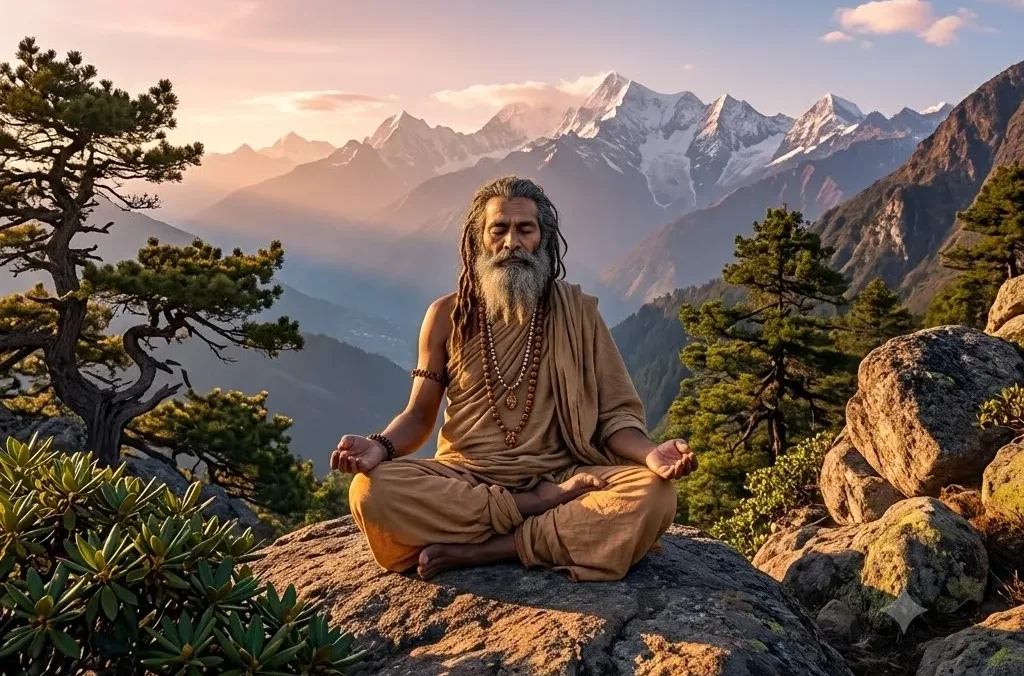
Life Keeps Changing, But Something Doesn’t
Look around you.
Nothing remains the same for very long. Children grow into adults. Youth slowly gives way to old age. Friendships begin and sometimes end. Health improves and declines. Fortunes are made and lost.
Your own body is living proof of change. Scientists tell us that over the years, most of the cells in our body are replaced. The person you see in today’s mirror is physically very different from the child who once stood before another mirror decades ago.
Your mind has changed just as much. Ideas that once seemed unquestionable have been replaced. Fears that once kept you awake no longer trouble you. Desires that once consumed your attention have quietly faded into memory.
Everything changes.
Yet something within you has quietly remained the same.
The Mystery Hidden Behind the Word “I”
Every day we use one small word without giving it much thought.
“I.”
It appears in almost every conversation.
I am happy.
I am worried.
I made a mistake.
I want to be free.
The word comes so naturally that we assume we know exactly what it refers to.
But do we?
When you say “I,” are you referring to your body? If so, which body? The one you had as a child, as a teenager, or the one you have today?
If you mean the mind, then which mind? The restless mind of your youth, the ambitious mind of adulthood, or the quieter mind that has come with experience?
Sri Ramakrishna gently encouraged seekers to investigate this simple word. Not intellectually, but through direct observation.
The Weight of a Story
Imagine carrying a heavy backpack every day.
After years of carrying it, you stop noticing its weight. It simply becomes part of your life.
Our psychological burdens work in much the same way.
Many of us carry stories about ourselves that have become so familiar we no longer question them. We tell ourselves we are unlucky, unworthy, broken, or permanently shaped by our past mistakes. These stories quietly influence every decision we make.
The strange thing is that the stories keep changing. New chapters are added, old ones are rewritten, yet we continue believing that the storyteller is always the same person.
Is that really true?
When Memory Becomes Identity
Memory is a remarkable gift.
Without it, we could not learn, grow, or recognise the people we love. But memory also has a darker side. It can persuade us that we are nothing more than the collection of experiences we remember.
A painful childhood becomes, “This is who I am.”
A failed marriage becomes, “This is my destiny.”
A business loss becomes, “I will never succeed again.”
Gradually, life is no longer experienced directly. It is filtered through yesterday’s conclusions.
Sri Ramakrishna did not ask people to erase their memories. He asked them to stop confusing memory with identity.
That difference changes everything.
The Invisible Prison
Most prisons have walls.
This one doesn’t.
No one locks the door from the outside. No chains are wrapped around our hands. We move freely through the world, yet many of us remain imprisoned by an image we have created of ourselves.
That image is built from memories, fears, achievements, failures, praise, criticism, and countless labels collected over a lifetime.
The prison feels real because we have lived inside it for so long.
Sri Ramakrishna’s question quietly begins dismantling those walls.
Who exactly is imprisoned?
The body?
The mind?
Or only an idea that has never been carefully examined?
Karma or Identification?
Suppose someone insults you.
The words are spoken in a few seconds.
The event is over.
Yet the mind keeps repeating it for days, sometimes for years. Every repetition gives the memory fresh life. The original event has ended, but the psychological suffering continues because we keep identifying with it.
Could the same be true of karma?
Perhaps actions certainly produce consequences. That is undeniable.
But does the suffering come only from the consequences, or does it come from our constant identification with the one who claims ownership of them?
Sri Ramakrishna invited seekers to examine this possibility with complete honesty.
Not to deny karma.
Not to escape responsibility.
But to understand the one who says, “This karma belongs to me.”
A Door Begins to Open
The more deeply we examine ourselves, the more surprising the journey becomes.
We begin by asking how to escape karma.
Soon we are asking who is actually carrying it.
That question changes the direction of our search.
Instead of looking outward for techniques, we begin looking inward for understanding. Instead of trying to repair an identity built by the mind, we start discovering something far more fundamental.
It is here that Sri Ramakrishna prepares us for one of the deepest insights in spiritual life.
If there is a witness behind every experience, can karma ever touch that witness?
That question will take us into a mystery that every human being experiences every single night—yet very few ever recognise.
Continue the Journey
Every night you enter a state where your name disappears, your worries disappear, and even the person you believe yourself to be quietly fades away.
What remains when all of that is absent?
Sri Ramakrishna’s answer reveals why your true nature has never been bound by karma and why freedom is not something to be achieved but something to be recognised.
Read the concluding article:
The Astonishing Truth About Karma: Why Karma Cannot Touch Your True Self
Further Reading
If this exploration of karma and Sri Ramakrishna’s teachings resonated with you, these articles will help you continue the journey:
Why Do We Take Birth Again and Again? A Deep Dive into Karma, Maya, and Moksha – Discover why the soul repeatedly takes birth and how karma shapes every lifetime.
What Happens After Death? Exploring Consciousness, Reincarnation, and Life Beyond Death – Explore what ancient wisdom and modern thought reveal about consciousness beyond physical death.
How Reincarnation Works and What Your Soul Experiences Between Lives – Understand the subtle process of rebirth and what the soul experiences before entering a new life.
Moksha: The Final Destination of Every Soul – Learn why liberation from the cycle of karma and rebirth is regarded as the highest human goal.
How to Find Your True Self: A Simple Path to Higher Consciousness – Begin the inward journey of discovering the witness beyond the ego.
Why Kutastha (Christ Consciousness) Makes You Naturally Magnetic – Understand the higher state of consciousness that naturally transforms one’s presence and perception.
Can Meditation Reveal Your Past, Future, and Hidden Potential? – Explore how meditation uncovers deeper layers of consciousness beyond the ordinary mind.
#Karma #SriRamakrishna #SpiritualAwakening #SelfRealization #WitnessConsciousness #Advaita #Consciousness #Meditation #InnerFreedom #SelfInquiry #NonDuality #SpiritualWisdom #HinduPhilosophy #Enlightenment #EastsideWriters


Pingback: The Life We Keep Waiting For: What Manifestation Really Means - Eastside Writers